The Right to Color
In her curatorial practice, Naz Kocadere explores the ways artistic expression takes shape in language and within relations of power. Here, she shifts her focus from words to the materiality...
read
Sevgi Ortaç

“Thinking with Concepts in Contemporary Art” has been supported as part of the SAHA Writing Series / Supported by SAHA Art Writing.
Playing Hooky
Our class is contemporary art. Outside, it’s freezing cold, while the classroom radiators are blasting heat. We are on a campus far away from the city; I am teaching, and our topic is the city. Now I need to recall a city experience. I don’t want to describe an experience I can’t remember. I can’t, for instance, explain the Situationist International. I can’t explain why they cut up maps. First I need to recall the city. Then I need to remember traversing the city. This city will not be just any background. It must be a city that can harbour the imagination. Oh no. The eyelids are getting heavy.
Perhaps it would help to return to the position of a student. You suddenly see the city opening up before you; as if you had escaped from a prison or an asylum, you say, “I broke out of school,” or “I played hooky.” I picture a resentful, downcast school. Wearing that uniform every morning had begun to wear down my pride. The city stretching out before us, there it is, and with it the curiosity, the uncertainty, the excitement of how a day might unfold. Where do you think are going… We’re going to the Biennial. That year it was at the Darphane-i Amire and other historical venues. In a somewhat ruinous courtyard enclosed by stone walls. There is a large table, covered with all sorts of odds and ends. You can take something and leave something else in its place. I do just that. Security approaches, I point to the text on the label describing the work, and they move away. As if staging a short play: for a brief moment we break out of being spectators, and art itself breaks out of being art; in this place where money used to be minted once upon a time, we experience a strange exchange, a kind of abundance.
I don’t remember what I left on the table, but what I took was a miniature schoolbag that, when opened, contained small slips of note paper. A small gift I could bring back to the resentful school. As I write this, I realize that I have still kept that miniature schoolbag. The most puzzling objects found in excavations are said to be toys, because they cannot be distinguished from the many ritual objects. We wander through art that promises a redistribution of merits, talents, abilities and what is sensible: A small practice, a brief ritual. I want to become friends, as soon as possible, with the people who set up this stall here. Since they have opened their stall to me, I think they must not be indifferent to me either. But our relationship won’t be nearly that easy.
The Problem of Storytelling
When I was invited to write on autonomy, especially on DÜRTÜK (Producers and Consumers in Resistance), I said, “What a perfect timing.” Right as I struggle to recall the city that can harbour the imagination, on this campus far from the city where the radiators are blasting heat; to think about urban movements, autonomy, alternative economies… History has no enforcer. “The world is divided between those who can and those who cannot afford the luxury of playing with words or images.” I find myself within a problem of storytelling. I am torn between making something the subject of a story and being made into a subject, between the comforts and the vulnerabilities of these positions. I do not claim that I will resolve this here, of course, but I would like to begin with a true proposal.
The True Proposal
One of the people and institutions invited to the Utopia exhibition to be held at the Tüyap Fair and Congress Center was the Kadıköy Tüketim Kooperatifi (Kadıköy Consumer Cooperative.) They called me and said, “We received such an invitation; we only know you from collectives, involved in art, come and lend a hand.” It was one of the most wonderful invitations I have ever received. It was as if art had become one of the many tasks within cooperativism. And the work of cooperativism had become art. I then called Fatma Belkıs, who at the time was part of the KABA HAT artists’ collective. She invited her friends from KABA HAT, and we formed an exhibition team.
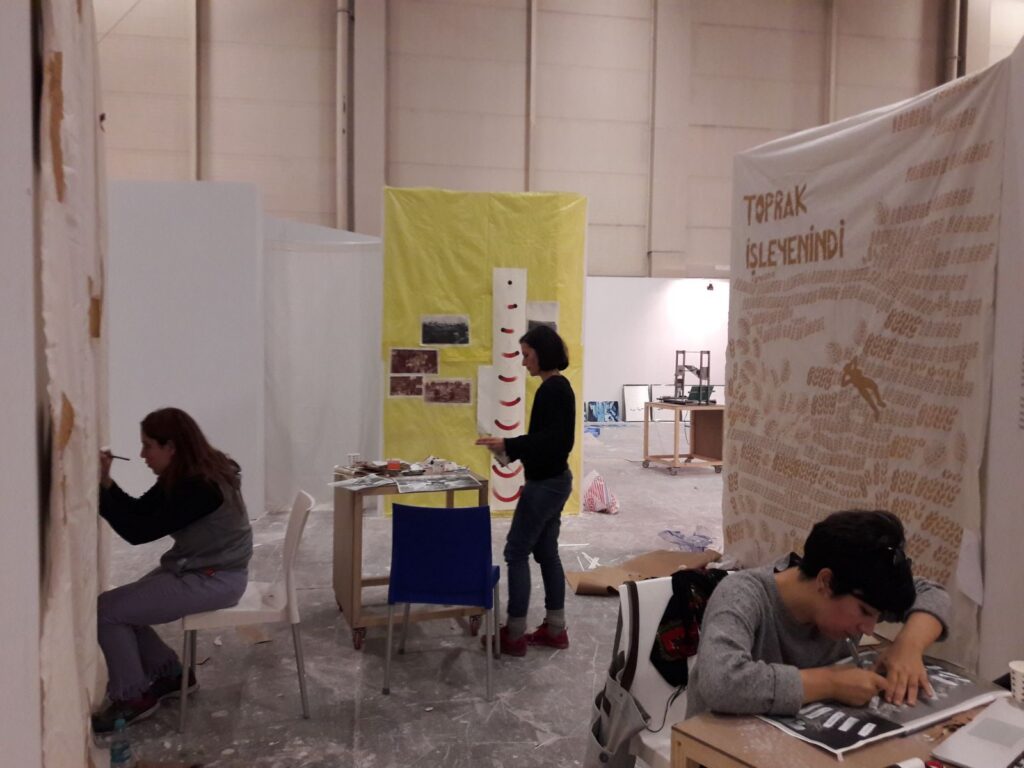
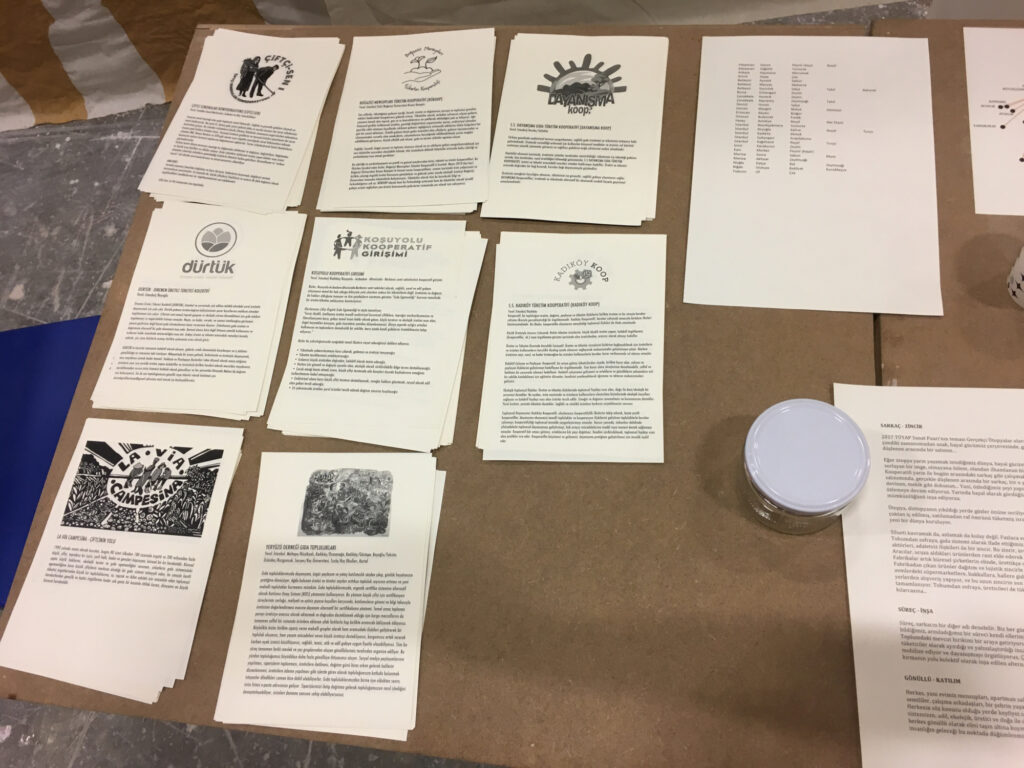
Our exhibition title, The True Proposal, comes from a diagram prepared by Çiftçi-Sen (Farmers Union). It is a diagram that proposes placing a producers’ organization and a consumers’ organization in place of the various intermediaries between farmer and consumer. In other words, organize production and consumption, remove the intermediaries. On a table in the exhibition, there are brochures describing food communities, olives offered as refreshments, a chart showing where the Kadıköy Consumer Cooperative sources what it provides, their manifesto text, and network maps that connect spaces and communities, extending from urban agriculture to different organizations.
Two of the three large posters on the walls are stenciled with clay on fabric. “Toprak İşleyenindi’’ (The Land Belonged to Those Who Cultivate It), with a wheat field below, and in the middle a woman lying back at ease. In another poster, figures gathered around a table, somewhere between tree, plant, and human—resembling wooden grave markers used in Anatolia—and at the center of the table the words read, “Gıda Egemenliği Hemen Şimdi” (Food Sovereignty Now). Food Sovereignty is a global movement that connects urban consumer organizations such as the Kadıköy Consumer Cooperative or DÜRTÜK (Producers and Consumers in Resistance) with food-based organizations of varying scales from many different localities around the world. It encompasses a wide range of actions, from community-supported agriculture to land occupations, from defending the rights of nomadic communities to establishing agroecology schools.
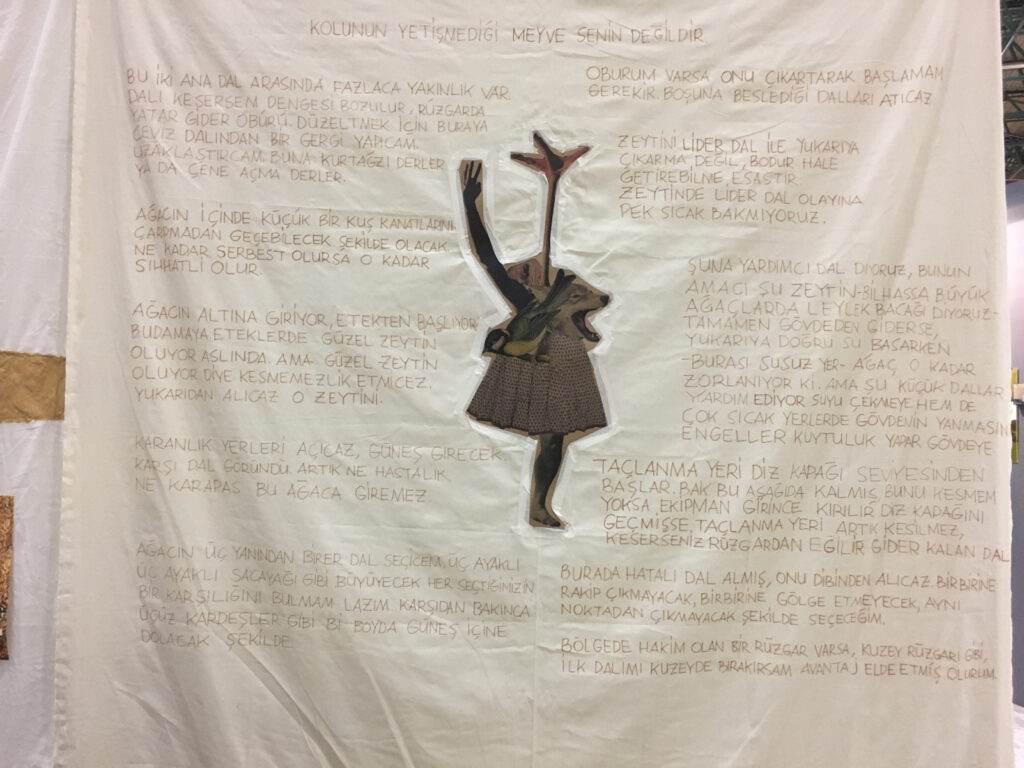
A third poster is about olive pruning. It begins, “The fruit your arm cannot reach is not yours,” and continues with other excerpts we compiled from educational programs on Çiftçi TV about how olives should be pruned to remain healthy and yield well: “We are not very fond of the idea of a dominant branch in olives.” Among the excerpts, there is a tree collage that brings together the terms used.
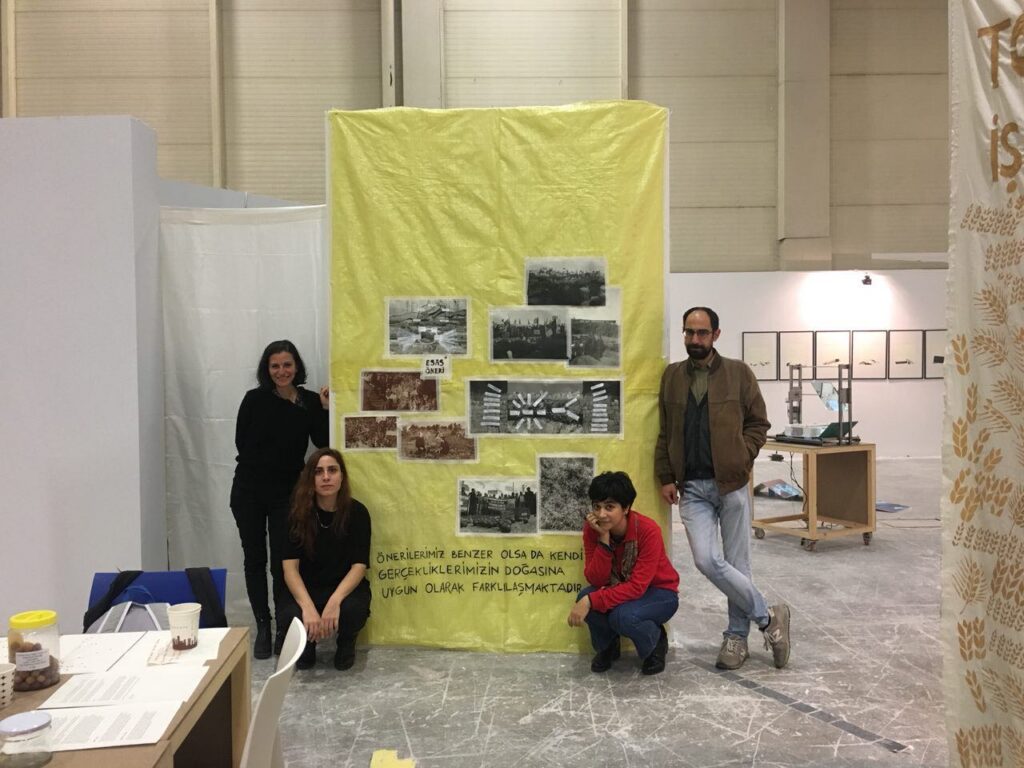
In the communities I mentioned, there is a method like this: when it comes to conveying the knowledge or experience of collectives, or making art about them, we want this to be done primarily by those who contribute labor to the collective, or for those who will do it to join the collective. We want the value that arises from the knowledge, experience, and story produced by the collective to be shared together, rather than being appropriated by an “outside” researcher or artist. Of course, this carries the risk of arriving at a kind of scarcity that could block the richness that might emerge from the complexity of these relationships. We are also aware that neither artists nor academics gain much from what they produce, and that their precarity is increasing. Yet the true proposal moves back and forth between the present and the future, it is negotiated. As written in the Kadıköy Cooperative exhibition manifesto: “…we are doing what we long for. We continue to long for what we cannot do…”
The Bostans (Urban Gardens)
I first encountered the İstanbul Kara Surları (Istanbul Land Walls) and the bostans in 2005, when I was a cinema student. With a camera in my hand—with a gaze that thematizes, even becomes enchanted—I recorded the neighborhoods stretching along the land walls, the marketplaces, the bostans, the informal economies, and the urban legends. In 2006, when Sulukule was declared a renewal area under Law No. 5366 and the Sulukule struggle began, this gaze started to transform. It would become a period in which many neighborhoods were opened up to profit through urban transformation and displacement, and in which a struggle grew, expanding from the right to housing to the right to the city, branching out from cultural heritage policies to ecology. It was a time when I moved back and forth between making something my subject and taking responsibility, when I saw the limits of what I could do with the tools I had, when I was in pursuit of doing something useful and doubted my art a great deal.
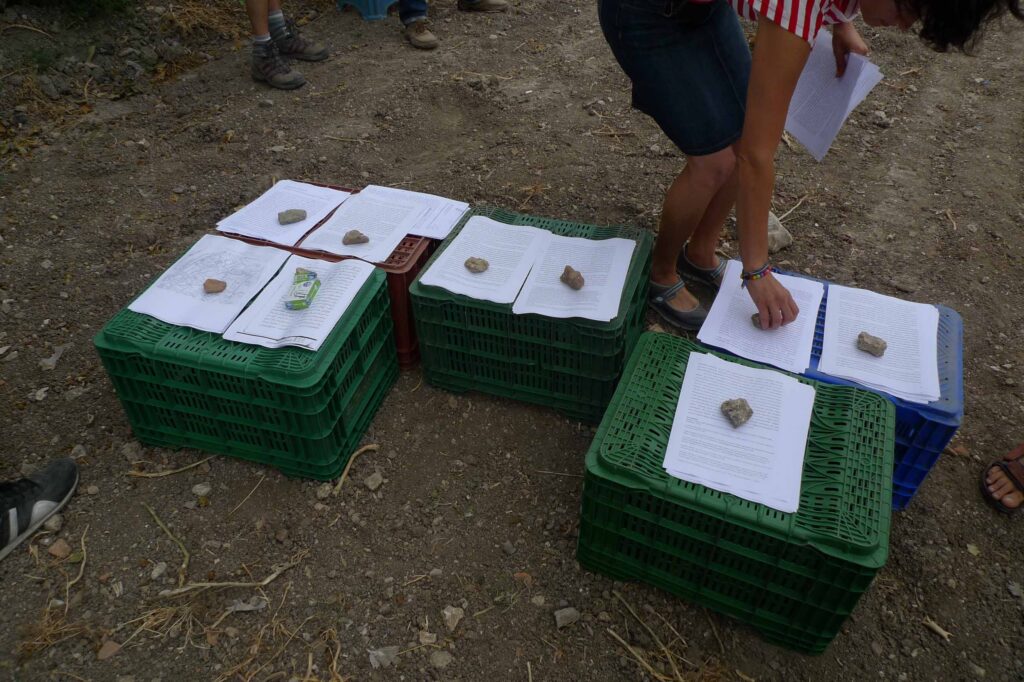
In July 2013, the Fatih Municipality would dump rubble onto the historic bostans under cultivation along the walls, with the aim of turning them into a “park and green area.” This came just as Gezi had spread into neighborhood forums, expanding people’s horizons about what could be expected from a city or neighborhood park. On one side, an urban movement that had gathered momentum; on the other, the uniqueness of a neighborhood. On one side, cultural heritage conventions; on the other, the livelihood of the bostan farmer growers. As group of people who wanted to “protect” the bostans, yet had different imaginations, priorities, or professional approaches regarding how this should be done, we came together in the Yedikule Bostanları Koruma Girişimi (Yedikule Bostan Protection Initiative). On the one hand, it was a ground where the strengths of different capacities came together, where archives, international conventions, the law, and creative action were set in motion. But on the other hand, it was also a ground where different forms of expertise and socio economic positions–with their privileges and vulnerabilities–collided in decision making and participation processes. There is no point in complaining, after all, it is a protection initiative. There are those who protect and those who are protected.
In the end, were the bostans saved? They are. The discussions about how they will continue, however, are ongoing: occupation fees, the economic precarity of the bostan growers, disagreements about land use… In 2017 or 2018, at a Food Communities workshop, I am in the same session as Özkan Ökten, a bostan grower in Silivrikapı. Before the meeting begins, we catch up briefly. I tell him that I have started teaching part time at a university. Özkan gives a response I did not expect at all. “Sevgi Abla, I cannot tell you how happy I am, I was wondering what’s going to happen to you. You have been running around for years, the bostans, the association. Honestly I feel so relieved!” He does not say that a burden has been lifted from him, but that is exactly what passes on to me. I too feel, in many areas, the relief of finally “becoming something of use.” And yet, this question of burden is interesting. I also feel a sense of concern and responsibility toward Özkan cultivating a piece of land left in between, without any security for the future. That is why I am here. But when does this become a burden? I will return to this case again and again. As I try to reopen the debates that the notion of volunteering tends to shut down, and think through the layered patterns of protection, of supporting and giving support in social movements, this will keep resurfacing.
A Companion Title to “The True Proposal”
“Even if our proposals are similar, they differ depending on the nature of our own realities.”
Organize production and consumption, remove the intermediaries. Fine. But the nature of our own realities may not always be something we can quickly grasp. In this text, I am grappling with this, and I am struggling a lot. This is where the story sheds grand narratives and takes on a more complex, more entangled form.
This may also be where autonomy comes into play. A capacity to sustain yourself, to set your own rules, to take care of yourself. Yet this appears to be, rather than independence, a more intricate way of being connected. It calls for a capacity and a force of care that exceeds not only the market relations we want to escape, but also those defined by home, family, work, expertise, and friendship. Here, as I write this text, I try to move forward by including the emotions that help thinking, or on the contrary, resist it. I try to recall what sustains an action, a way of living that brings neither a salary, nor a title, nor a written thesis, nor a produced artwork; the energies, resources, and bonds that sustain it.
DÜRTÜK
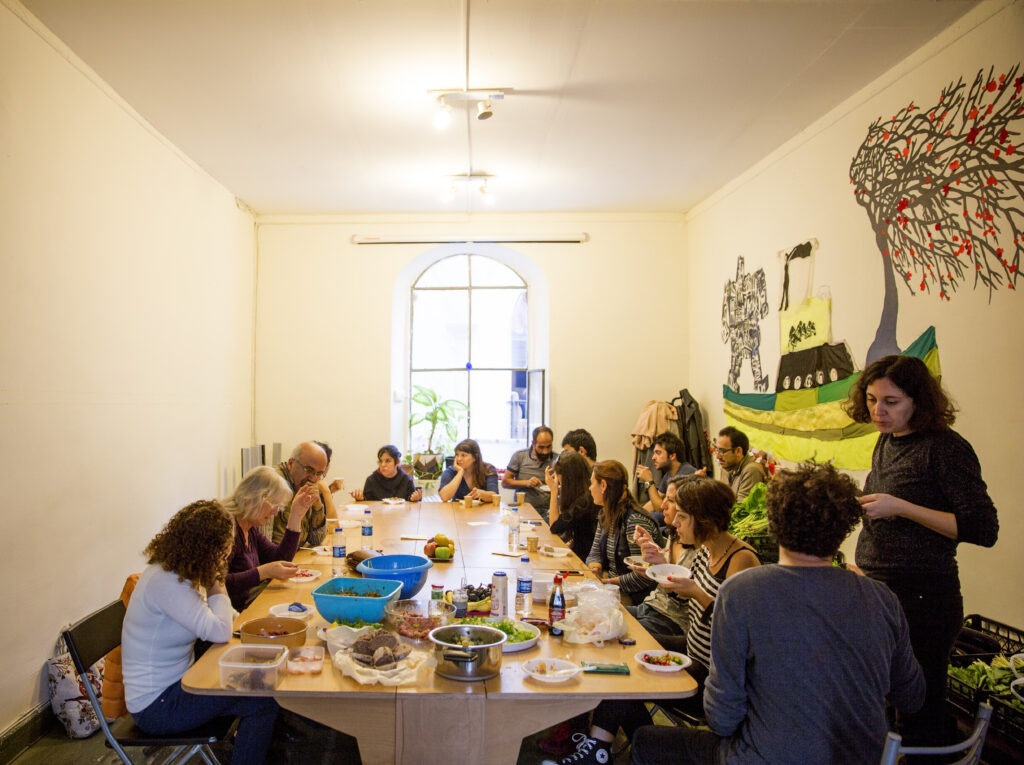
Most of the time, on Sunday evenings, we do what we call “the calling”: checking in with Özkan in Yedikule, or Mehmet or Cemile from the Piyalepaşa bostans, seeing how they are, finding out if there are any developments, learning what produce is available, and agreeing on the price we will pay. This is a call that moves back and forth, outside of urgencies, between the planting cycles of the bostans and the meeting times of the collective, between two neighborhoods, between different agendas. And then there is the car—and the driver. They too move between Beyoğlu and the bostans. They carry crates, shake hands, hit the roads, and bring the greenery. The crates of greenery enter through the back door of Hazzopulo Passage, pass through the door between Rita’s second hand shop and Mustafa the coffee seller, and arrive at Dünyada Mekan on the first floor. Those who place orders come here on Thursday evenings. We meet here, handle the distribution, and chat. DÜRTÜK distributions continue from October 2015 until May 2018. Remembering DÜRTÜK intertwines with remembering what we lived through in Turkey during those years. I will not be able to handle this act of remembering in this text. Instead, I can share the event announcement below, (or the caterpillar on the table).
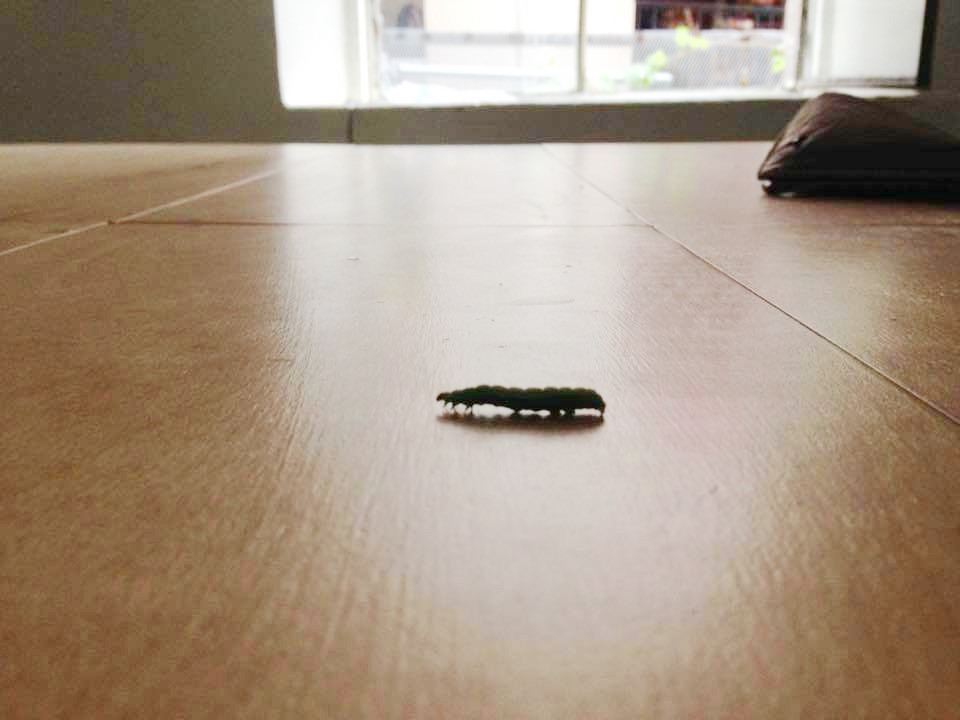
27 March 2016, event text on Facebook:
Let us weather these gloomy days together and also welcome the spring together, dear DÜRTÜK members. Let us meet this Sunday, set up an open market, get to know who have newly joined us; let us talk with those who want to take part in DÜRTÜK’s division of tasks in the spring months, and with those who are curious about how this mill turns. We are also preparing a small handbook for DÜRTÜK. Our booklet, which we will distribute on Sunday, is being printed by BAÇOY-KOOP.
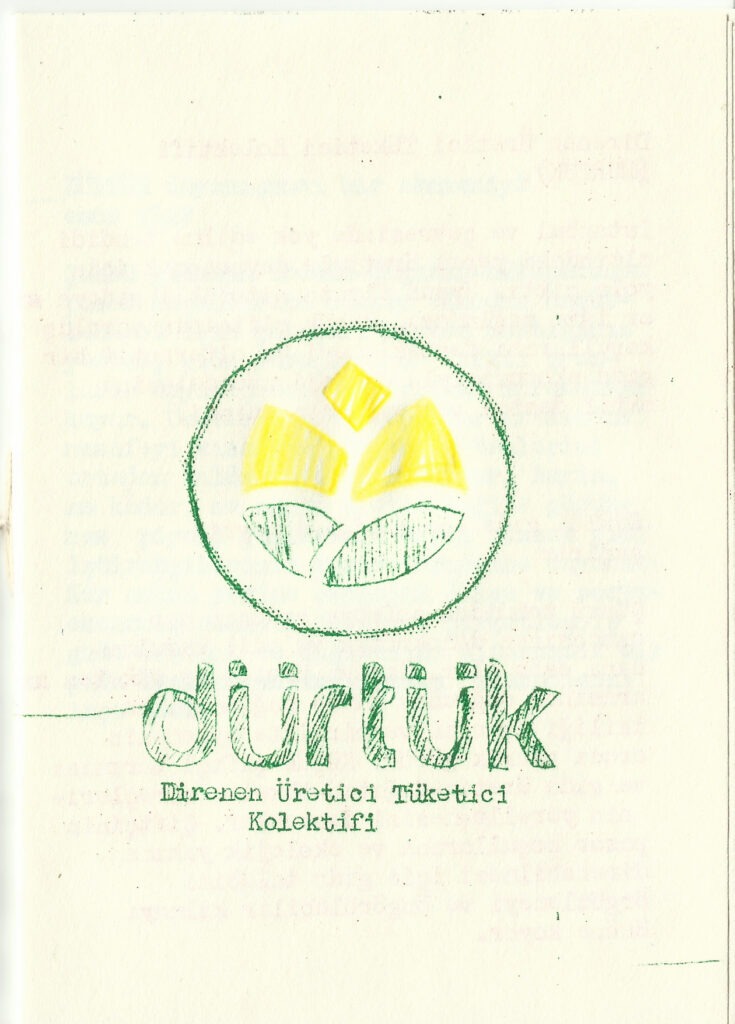
DÜRTÜK handbook. Printed in March 2016 by BAÇOY-KOOP using stencil duplication technology.
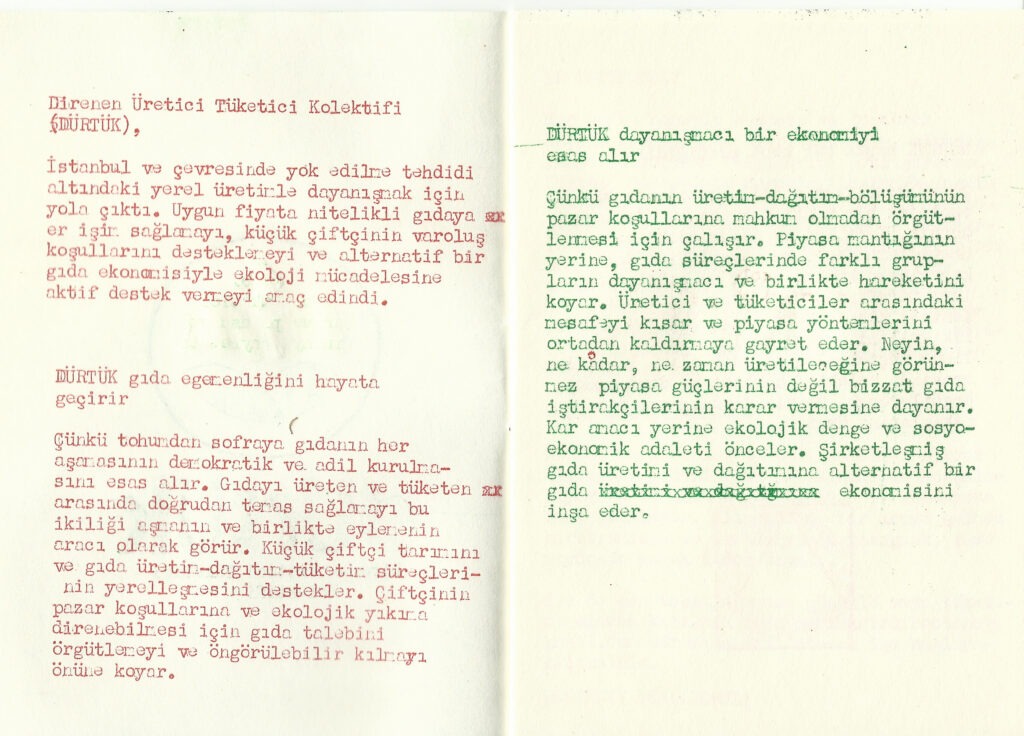
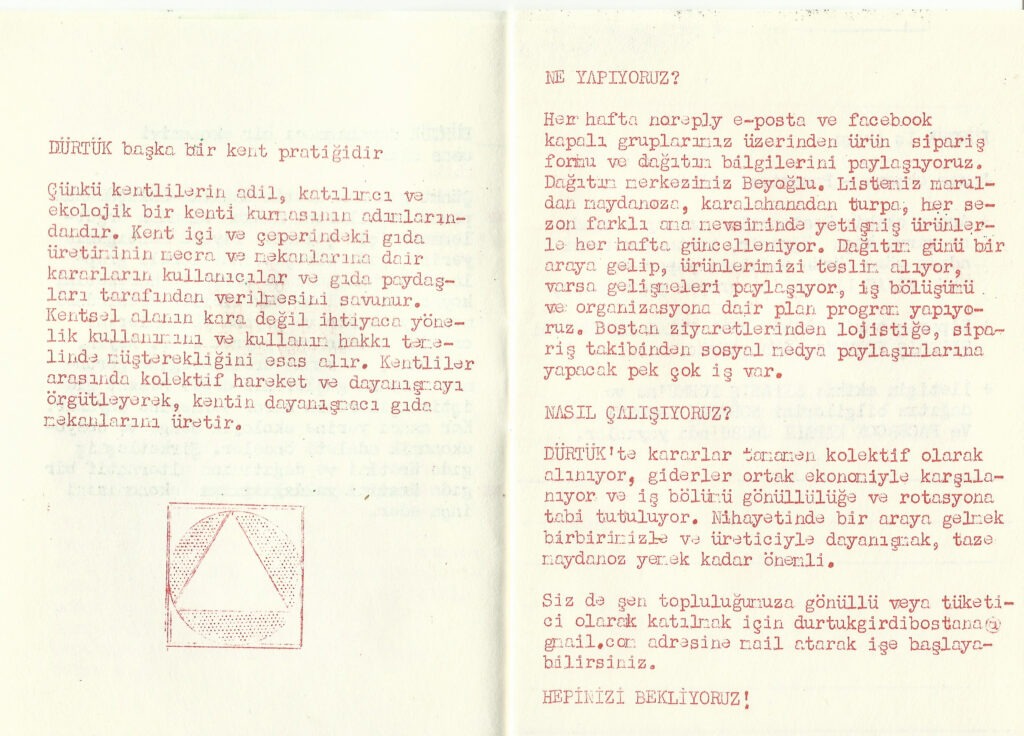
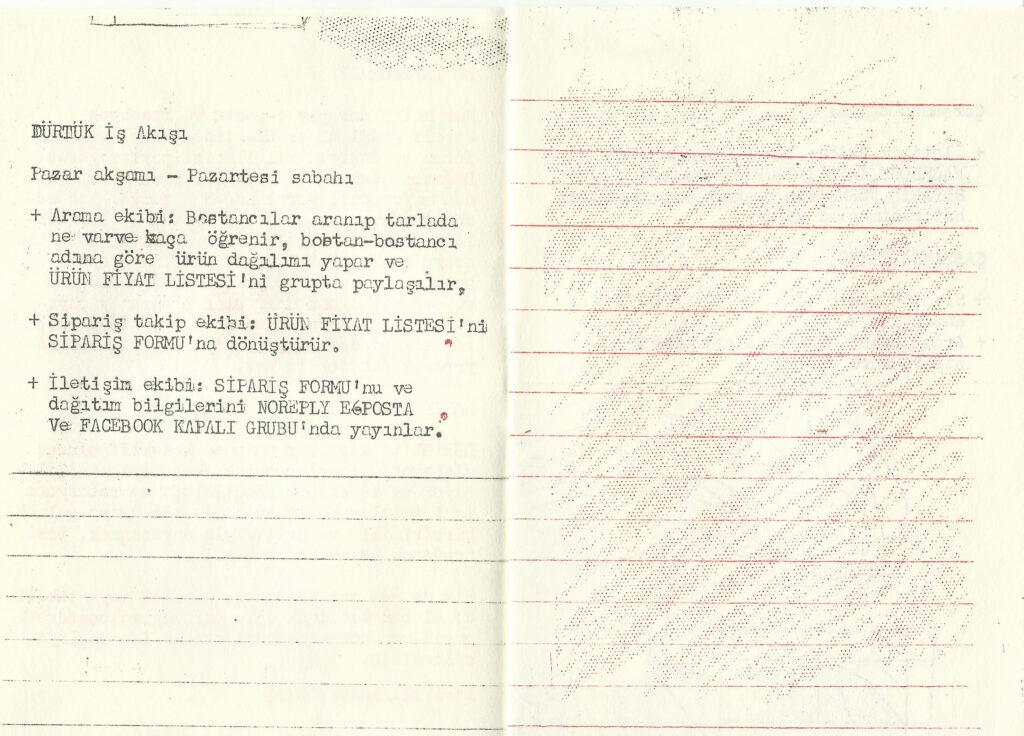
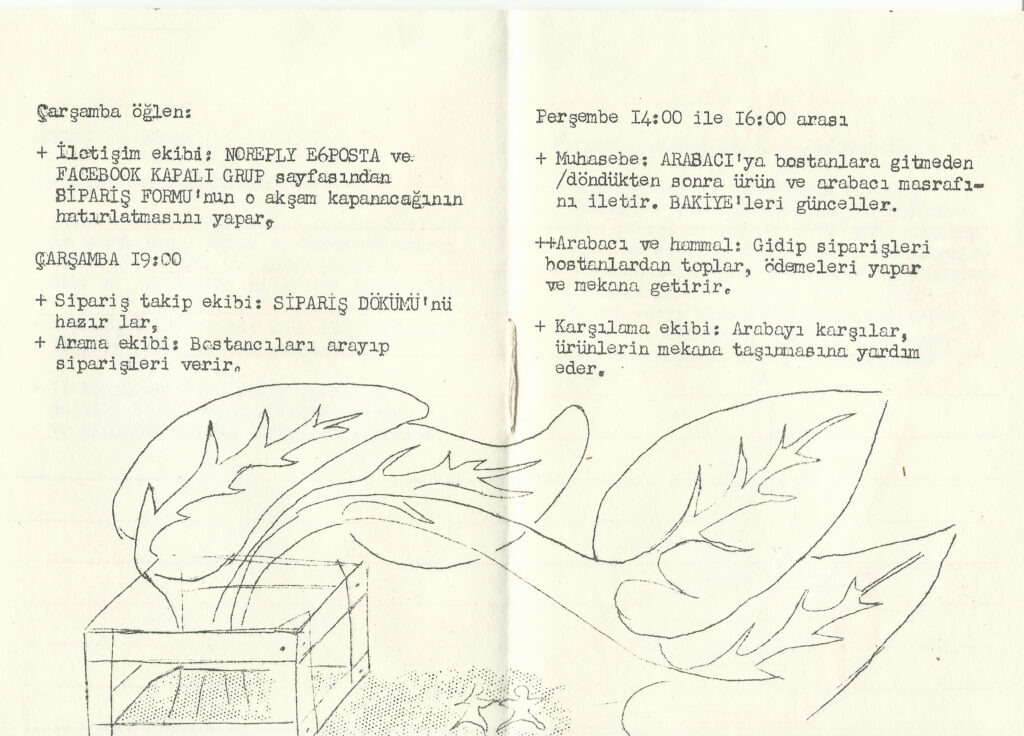
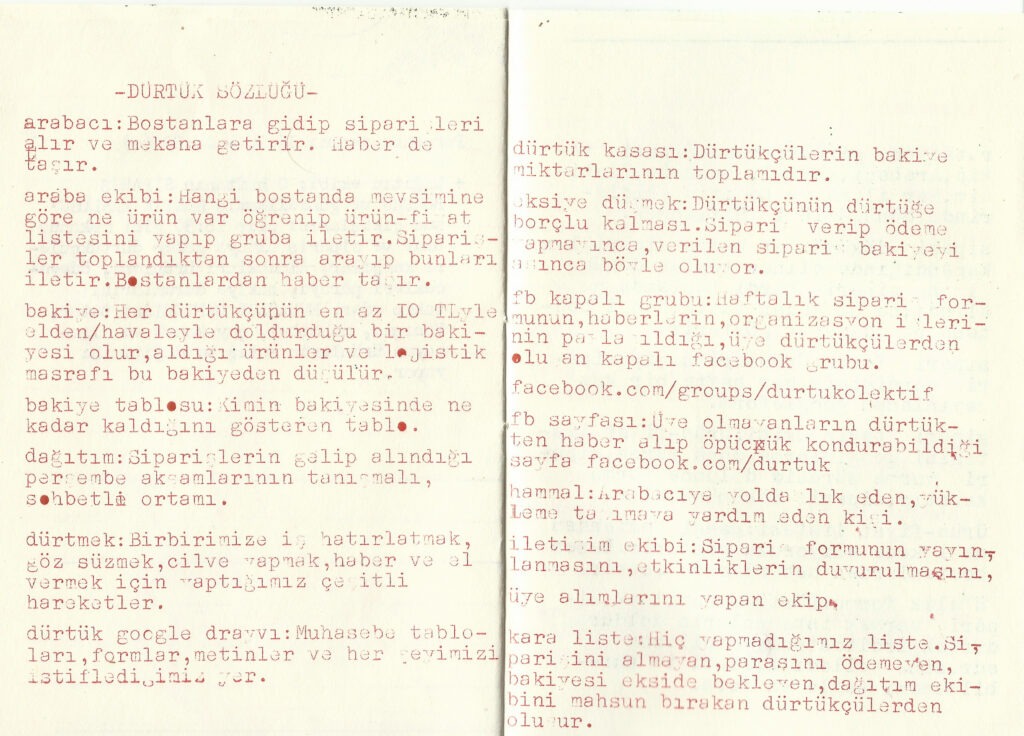
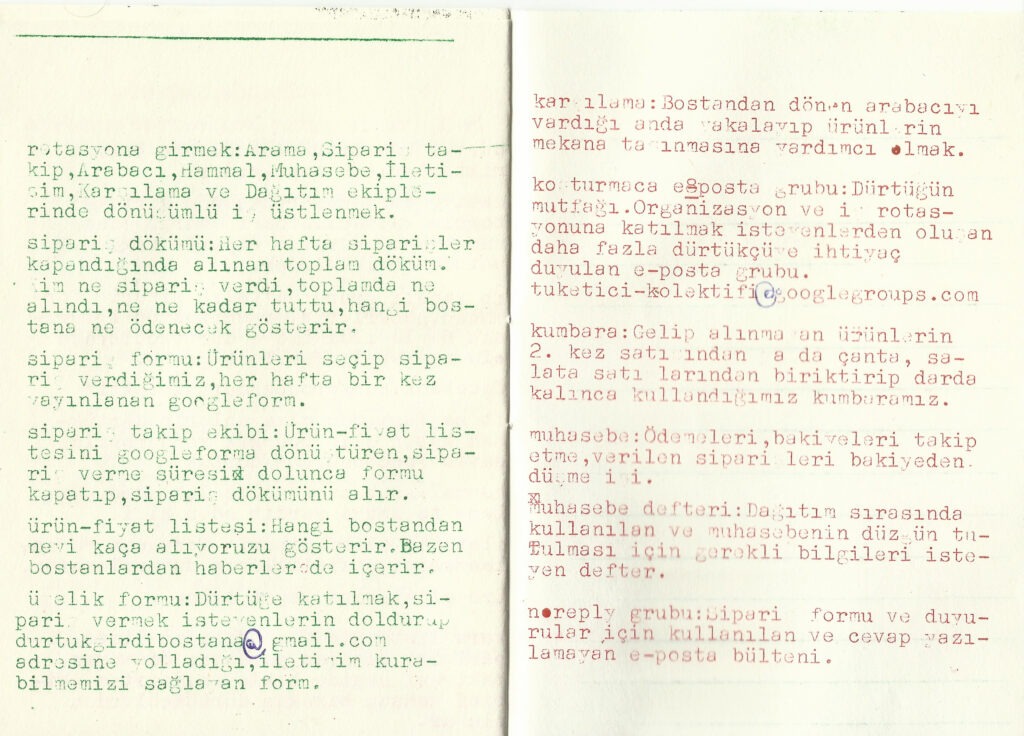

One week after the bomb attacks in Ankara Güvenpark and Istanbul İstiklal Avenue, we meet at Dünyada Mekan. Like most urban food communities, DÜRTÜK takes a neighborhood as its base. This is a place that spills outward, from Tarlabaşı to Taksim Square, from Galatasaray Square to Tünel, from its everyday life to its life in people’s minds. After Gezi, the foundations of many new solidarity networks and communities were laid in neighborhood forums. Neighborhood based food communities, some collectives and some cooperatives, in different organizational forms, were part of this broad civil field that both preceded Gezi and expanded with it. It may be possible to remember and imagine the nature of our own realities within this outward flowing network, or rather within these bonds.
Our Stalls
In 2016, as March 8 approaches, we organize the first joint solidarity bazaar that we will join as DÜRTÜK. Mor Çatı Kadın Sığınağı Vakfı (Mor Çatı Women’s Shelter Foundation), Cinsel Şiddetle Mücadele Derneği (Association for Struggle Against Sexual Violence), Komşu Kafe kolektifi (Komşu Kafe Collective), Özgür Kazova, Lambda İstanbul, Kader Kısmet Atölyesi (Kader Kιsmet Workshop), Göçmen Kadınlar (Migrant Women), Göçmen Dayanışma Mutfağı (Migrant Solidarity Kitchen), İş Cinayetleri Almanak Ekibi (The Work Murders Almanac Team), Don Kişot İşgal Evi Kolektifi (Don Quixote Occupation House Collective) will set up stalls. We are looking for a place. At that time, the eviction case of Eller Art Gallery is being heard. Earlier, Kelebek Korse had also been evicted from Santa Maria Han under the law that grants property owners the right to evict tenants who have completed ten years, without providing any justified reason.
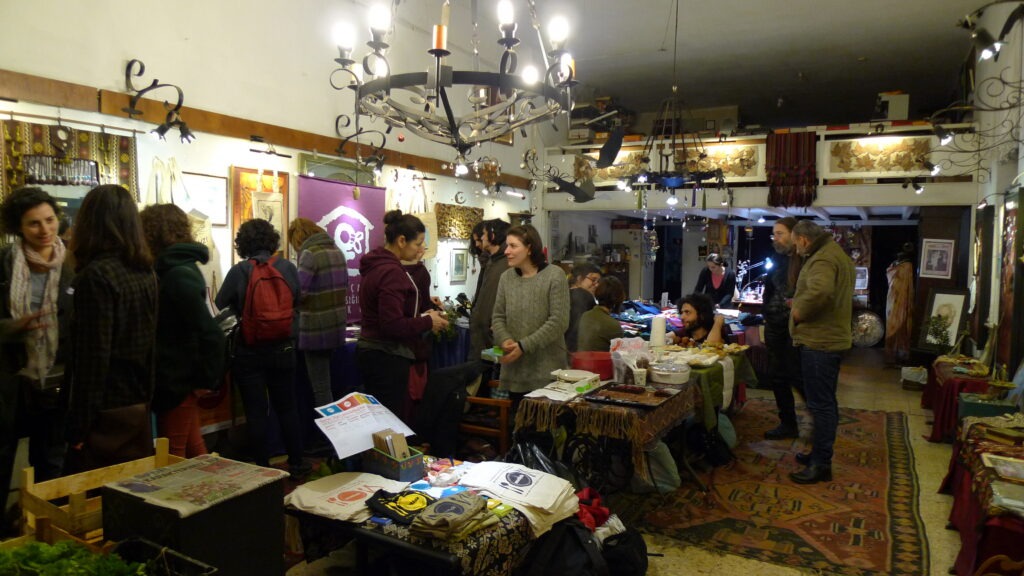
Eller Art Gallery is a workshop and gallery located on the Postacılar Street side of Santa Maria Han. Nurhan Acun produces jewelry with motifs from Anatolian civilizations and makes reproductions of works found in museums. It is a place between an art gallery and a craft workshop, within a vast network of craftsmanship and small scale production that stretches from Perşembe Pazarı to Şişhane, connecting everything from material suppliers to workshops, from ship parts to chandeliers. I too had apprenticed in this workshop during summers in the 1990s. Years later, we go to Nurhan Bey with our bazaar proposal. He accepts. Among the jewelry stalls, there are books, lettuce, handicrafts, and lentil patties…
The Joint Solidarity Bazaars will come together with new participants in different venues, from Beyoğlu to Kadıköy. At a time when public space is rapidly shrinking, while leaving the house is becoming increasingly difficult, while Beyoğlu is losing residents to other neighborhoods, while we are becoming impoverished in many ways, they will become the place of a strange abundance, an unusual exchange.
The Sound of the Shutter
What I struggled with most in the encounters in the bostans after Gezi were those unsettling brushings up against hierarchical positions, like a parachuting activist or an educated ‘savior’ dispensing wisdom. On one side there was the police, on the other the sharp political presence of Gezi; the image of “outsiders” sometimes circulated in neighborhood meetings and encounters.
At the end of three years, when the edikule Association of Bostan Growers reached the stage of being founded, a space was found for the association. A few friends and I went for painting and repairs. It was a shop on the main road heading up to Yedikule. I remember feeling an odd sense of relief as we opened the shutter, together with the noise spreading into the street. For a moment, it felt as if we were in the right place. In the association’s charter, we wrote that only bostan growers could become members.
Kuçe
As I write this, as I think about the nature of our own realities, as I try to imagine what comes next for these communities, I notice that instead of the bitterness of the period we are living through, I focus on what we have failed to do, on what we could have done better. As if everything were in our hands. Or isn’t it?
By the end of 2017, the Kuçe Food Collective had set out on its path, taking over a small restaurant called 3. Mevki on Öğüt Street in Beyoğlu, where dishes were sent up from the kitchen to the ground floor by a lift system. Kuçe too had shutters that roared when it opened. And a tax certificate.
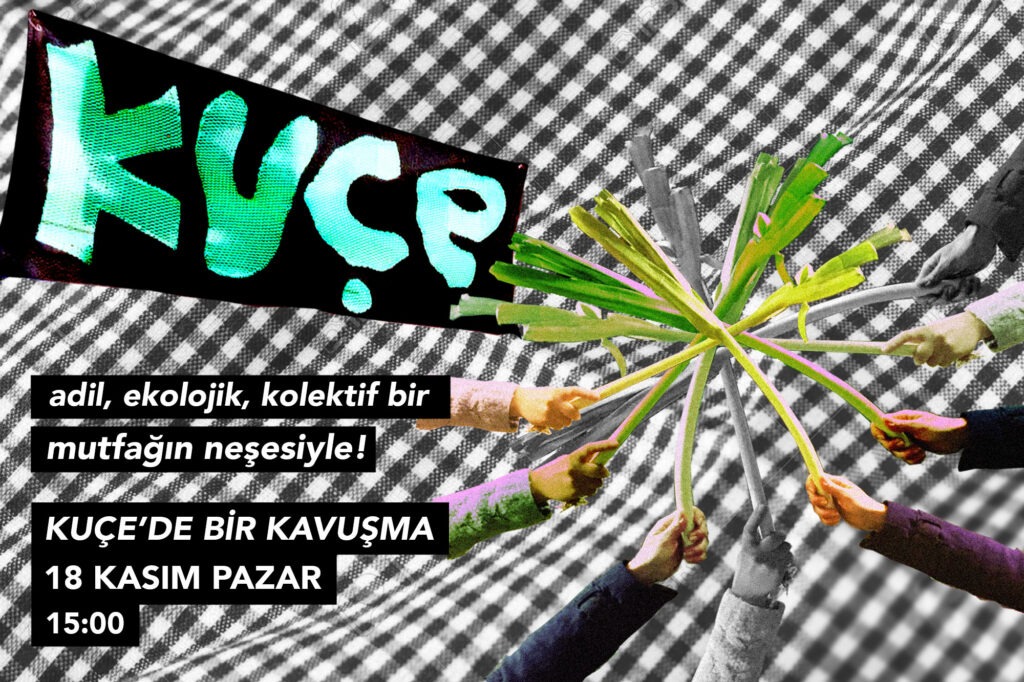
As of March 2018, I and a few more friends joined the collective, and we had a place that was open six days a week. The only cook among us was Meryem, who had remained from 3. Mevki and continued to work with us. There were, more or less, six or seven of us who learned by doing, who kept the restaurant running regularly; around us were the ones we stayed in close contact with: friends, producers, cooperatives, collectives…
September 30, 2018 Kuçe Food Collective Introduction Meeting (Facebook Post)
Kuçe Food Collective cooks together and thinks while cooking; we wonder whether we can grow in this kitchen, whether we can both feed ourselves and turn collective production into a long-term structure of support for one another.
Kuçe had set out with a team of women who were already in contact with one another through different horizontal forms of organizing, arriving with both shared and divergent experiences and forms of exhaustion, and living in precarious conditions, working freelance, or unemployed. In this story, where I try to move forward by making my own position explicit, Kuçe stood at a point where we could reopen discussions that the notion of voluntarism tends to foreclose, lay out our increasingly shrinking space for action and growing precarity, and turn our attention to the question of self-care within organizing. On the horizon was the core proposal of becoming a public-facing model, a cooperative that could expand into different fields of production. Kuçe became a meeting point stretching from the cost calculations of a plate of food to the tools of self-expression, from shopkeeping to the street; a place where we renegotiated skills and positions, where we both cooked and ate.
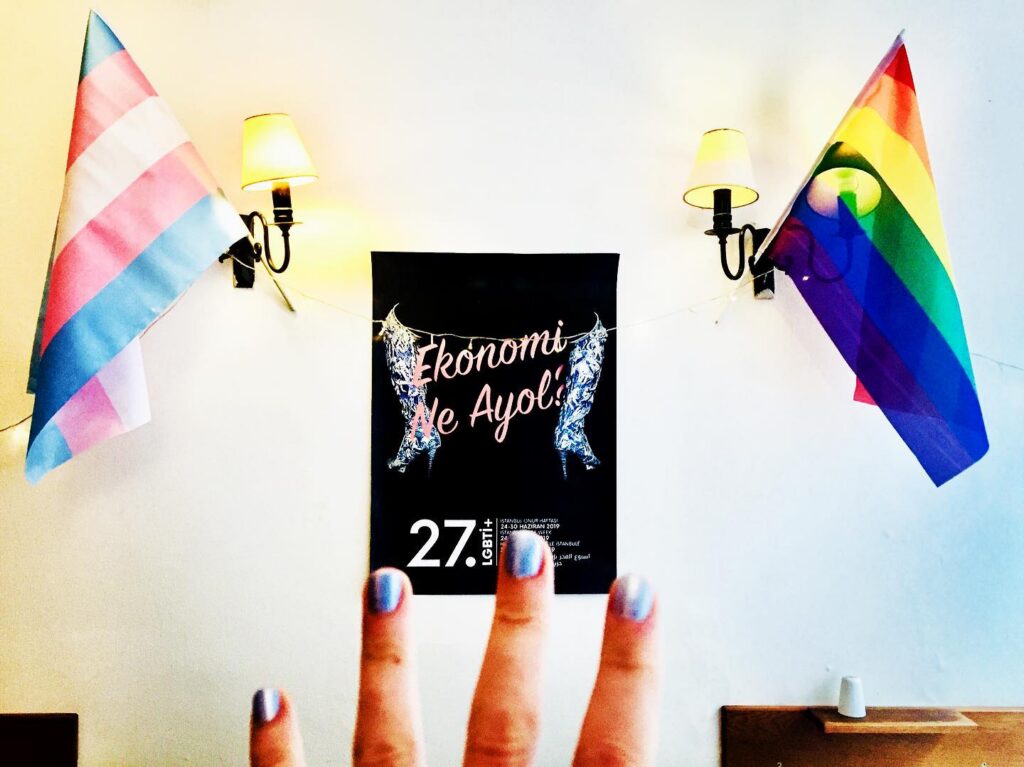
In the summer of 2020, the Kuçe Collective ended both its collective and restaurant activities and left its space to the Beyoğlu Food Community. In the following years, many food communities such as the Beşiktaş Cooperative, Koşuyolu Cooperative, and Kadıköy Cooperative also decided not to continue. As I write this, a workshop has been organized to share and collectively evaluate the data of a study focusing on why these communities came to an end. The visible reasons were centered on the economic crisis and the pandemic: rising food prices, rents, transportation costs, the burden on volunteers, internal disagreements… Yet the analysis of the collected data also showed that these communities could have continued under these conditions but chose not to. As if everything were in our hands… Or isn’t it?
I would like to end this story once again with a true proposal.
Those Who Speak Less
We are at a food sovereignty forum in Cluj, Romania. For the forum, a large marquee set up in a marketplace near the city center is used as a fairground. More than 500 people gather here to talk and make decisions together. Participation from Turkey is organized by Çiftçi-SEN. I do not know how many different languages are spoken in total, but there are people from more than 40 countries, and everyone is encouraged to speak in their mother tongue. For this purpose, a collective that develops open-source simultaneous interpretation technologies and makes them available for shared use is present in the space with handheld radios, transmitters, and headphones.
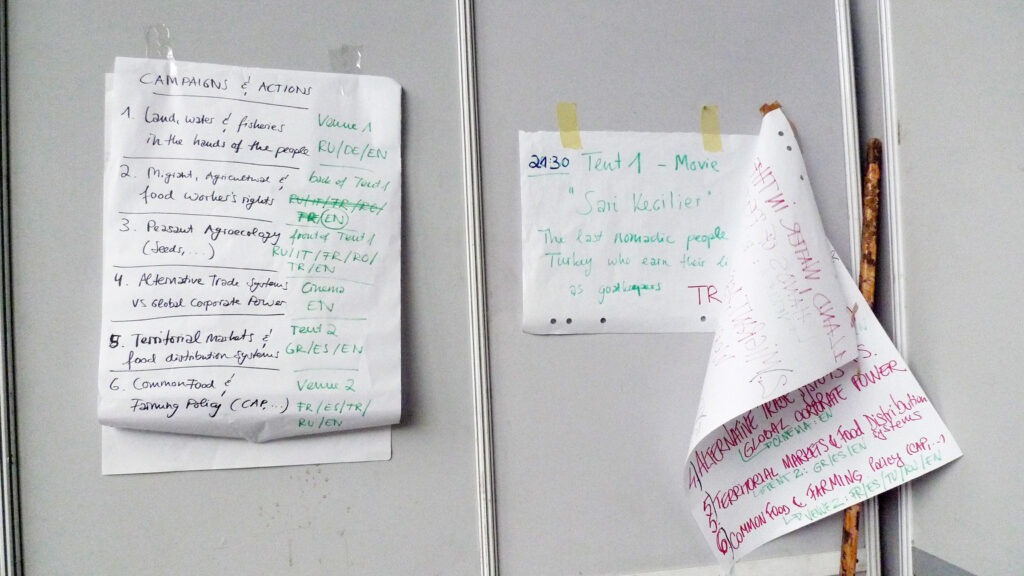
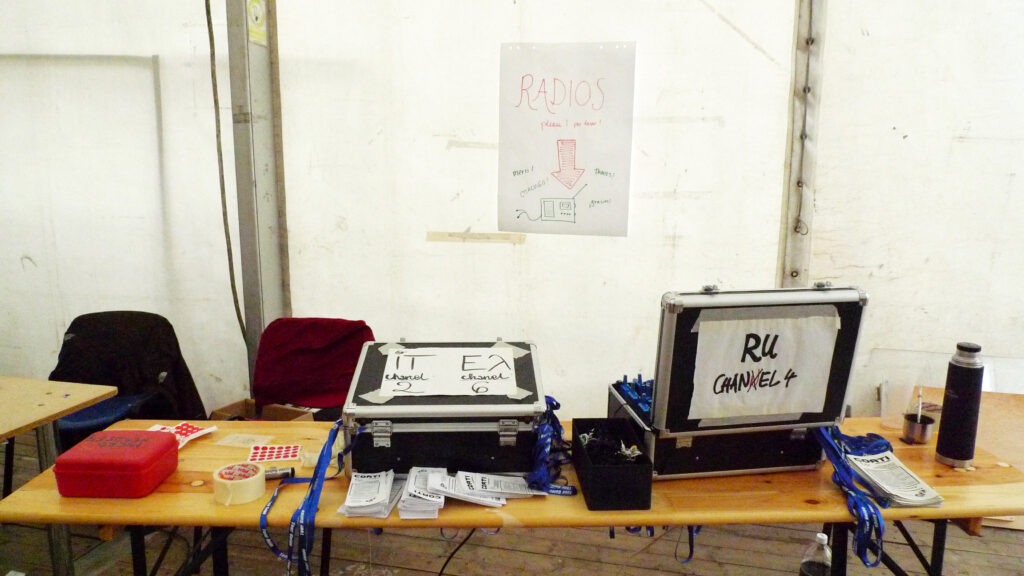
On the first day, session topics are determined and it is decided in advance who will attend which meeting. Accordingly, the languages to be spoken are set and interpretation teams are formed. These teams are supported by volunteers brought by each delegation. A local food collective organizes the meals. Products sourced from local producers are cooked and distributed together with volunteers from the visiting delegations. Dishwashing and cleaning tasks are shared in the same way.
At the beginning of each session, the groups with the least representation are identified first: How many fishers are among us? How many nomads? How many women producers? These people stand up and allow themselves to be visible; everyone sees them, and then they sit down again. Only then does the meeting begin.
At the forum in Cluj, I meet Pervin Çoban Savran from the Sarıkeçililer. She talks about how, along the transhumance route they travel with their animals, forest and pasture lands are increasingly being closed off, fenced in by private property, and how villagers are reluctant to share their grazing lands and water sources. I hesitate, wondering whether I might disturb them, turn them into a subject, make them feel like something to be looked at. She does not linger on it at all. “We don’t have a door,” she says.
References and Notes
[1] The Situationist International was an avant-garde movement active between 1957 and 1972 that combined art and politics. It is known for concepts such as the experience of the city, “drifting” (dérive), and the critique of the existing order.
[2] The biennial in question is the 7th edition of the Istanbul Biennial, held in 2001 under the title Egofugal: Fugue from Ego for the Next Emergence.
[3] Agamben, Giorgio. Infancy and History. Translated by B. Parlak. Kanat Kitap (2010).
[4] Ross, Kristin. Communal Luxury: The Political Imaginary of the Paris Commune. Translated by T. Birkan. Metis Publications, Istanbul (2016).
[5] Utopia was the title of the project exhibition of Artist 2017, held within the scope of the 27th Istanbul Art Fair. Coordinated by Eda Yiğit and Ezgi Bakçay, and with the participation of numerous curators and institutions, it took place at TÜYAP between November 4–12, 2017.
[6] In the exhibition credits, we listed “Friends of the Kadıköy Cooperative” as the curator. The artists were Fatma Belkıs, Bengi Güldoğan, Merve Kılıçer, Nihan Somay, and Sevgi Ortaç.
[7] Confederation of Farmers’ Unions. https://www.ciftcisen.org/
[8] This scheme proposes replacing intermediaries such as traders, brokers, transporters, distributors, and supermarkets, who currently stand between farmers and consumers, with a direct relationship between producer organizations and consumer organizations.
[9] Food sovereignty is a concept introduced by La Via Campesina at the 1996 World Food Summit; it defines food not as a commodity but as a right, and defends the right of peoples to determine their own agricultural, food, and ecological policies. https://viacampesina.org
[10] Examples include different local models such as MST in Brazil, which occupies land and establishes its own schools and cooperatives, and AMAP in France, where consumers pre-finance production and share the risks of the harvest. https://mst.org.br / https://reseau-amap.org
[11] Sulukule is a neighborhood located along the land walls of Istanbul, historically inhabited by a Romani population; it came to public attention in the 2000s due to urban transformation projects and displacement.
[12] Law No. 5366, titled “Law on the Renewal, Protection, and Use of Deteriorated Historical and Cultural Immovable Properties,” came into force in November 2005 and paved the way for redevelopment projects in historic areas.
[13] The historic bostans stretching along the land walls of Istanbul are among the oldest examples of urban agriculture, with continuous production since the Byzantine period.
[14] The Gezi Park protests were a social movement that began in Istanbul in 2013 and spread across Turkey, developing around demands for the right to the city, public space, and democratic participation.
[15] After Gezi, parks began to be rethought in relation to urgent needs such as earthquakes, climate, and food crises; they started to function as spaces of non-market solidarity and collective production. The “recreational area” approach proposed by municipalities for the bostans remained disconnected from these social needs, reducing green space to a passive backdrop while also turning it into a tool for urban rent and marketing.
[16] This statement is taken from the Marabá Declaration (April 17, 2016), issued at the International Agrarian Reform Conference held in Marabá, in the state of Pará, Brazil, by 130 delegates from 10 regions and 28 countries representing La Via Campesina member and allied organizations. https://www.karasaban.net/maraba-deklarasyonu-topragi-savunmak-ve-yasami-onurlandirmak-icin/ (Accessed: March 31, 2026)
[17] Dünyada Mekan was a collective space without offices, where freelance and white-collar workers could work together or individually during the day, and where events and meetings could be organized.
[18] BAÇOY-KOOP (Printing, Reproduction, and Distribution Cooperative) uses mimeograph technology. It researches how organizations and individuals within the leftist movement in Turkey used mimeograph machines for collective and independent publishing and distribution; based on this research, it produces and distributes printed materials. In addition to its own production, it shares its means of production with self-organized groups.
[19] The bomb attacks that took place in 2016 in Güvenpark in Ankara and on İstiklal Avenue in Istanbul resulted in the deaths and injuries of many civilians, and had profound effects on the safety of public space and everyday life in Turkey.
[20] The formations referred to are various civil society structures in Turkey working on feminism, labor, ecology, and solidarity, taking different forms ranging from foundations to collectives, associations, and spaces.
[21] Changes in tenancy regulations in Turkey made it easier to evict tenants who had completed a certain period, creating significant pressure especially on small businesses, workshops, and independent spaces in city centers.
[22] Volunteering is a concept we use to describe a type of relation different from the interest-based relations we associate with capitalism: having no personal gain, not making a profit, not generating income. At the same time, it invokes a fantasy in which its purpose and returns are positioned above others, as something more special. The issue of volunteer fatigue is frequently discussed in meetings and workshops. As a solution, instead of paid work, we most often propose increasing our numbers.
[23] The Beyoğlu Food Community is a food collective in Istanbul that aims to establish a direct relationship between consumers and producers who provide fair, local, and healthy food. https://www.instagram.com/beyoglugida/
[24] The Kadıköy Cooperative is a consumer cooperative that aims to build a solidarity network without intermediaries between producers and consumers; following its closure, an archive prepared for the transfer of its experience is available at https://kadikoykoop.vercel.app
[25] After 2020, 28 Alternative Food Initiatives came to an end. Orkun Doğan, March 15, 2026, Workshop on Food Communities and Consumer Cooperatives.
[26] The Workshop on Food Communities and Consumer Cooperatives, held on March 14, 2026 at Postane in collaboration with the Adil Food Community, was organized within the scope of the research project “Alternative Food Initiatives in the Face of Multiple Crises,” conducted with the support of Özyeğin University’s Social Impact Seed Program. Project coordinators and researchers: Orkun Doğan, Oya İklil Selçuk, and Candan Türkkan.
[27] The European Nyéléni Food Sovereignty Forum, held in Cluj, Romania, is an international gathering that brings together farmers’ organizations, cooperatives, and food communities from different countries. https://www.karasaban.net/avrupa-nyeleni-gida-egemenligi-forumu-romanyada-toplaniyor/
[28] COATI (Collective for Open and Accessible Translation Infrastructure) is a collective that develops open-source interpretation tools enabling participants in multilingual meetings to speak in their native languages. https://coati.pimienta.org/the-collective/index.en.html
[29] The Sarıkeçililer are one of the Yörük communities in Turkey’s Taurus region, engaged in pastoralism through seasonal migration; they sustain their production by moving between summer and winter pastures.
[1] Durumcu Enternasyonal (Situationist International), 1957-1972 arasında etkin olan, sanat ile politikayı birleştiren avangard bir hareket. Kent deneyimi, “sürüklenme” (dérive) ve mevcut düzenin eleştirisi gibi kavramlarla bilinir.
[2] Bahsi geçen bienal, 2001 yılında yapılan, İstanbul Bienali’nin Egokaç—Gelecek Oluşum için Egodan Kaçış konulu 7. edisyonudur.
[3] Agamben, Giorgio. “Çocukluk ve tarih.” B. Parlak, Çev.) Kanat Kitap (2010).
[4] Ross, Kristin. “Ortak Lüks, Paris Komünü’nün Siyasi Muhayyilesi.” Basım, T. Birkan (çev.) Metis Yay. İstanbul (2016).
[5] Ütopya, 27. İstanbul Sanat Fuarı kapsamındaki Artist 2017’nin proje sergisinin başlığıdır. Eda Yiğit ve Ezgi Bakçay koordinasyonunda, çok sayıda küratör ve kurumun katılımıyla 4–12 Kasım 2017 tarihleri arasında TÜYAP’ta gerçekleşti.
[6] Sergi künyesine küratör olarak Kadıköy Kooperatifi Dostları yazdık. Sanatçılar ise Fatma Belkıs, Bengi Güldoğan, Merve Kılıçer, Nihan Somay ve Sevgi Ortaç idi.
[7] Çiftçi Sendikaları Konfederasyonu. https://www.ciftcisen.org/
[8] Bu şema, mevcut durumda çiftçi ile tüketici arasına giren tüccar, komisyoncu, nakliyeci, sevkiyatçı ve market gibi aracıların yerine, doğrudan üretici örgütü ile tüketici örgütü arasında kurulan bir ilişkiyi önerir.
[9] Gıda Egemenliği, 1996 Dünya Gıda Zirvesi’nde La Via Campesina tarafından ortaya atılan bir kavramdır; gıdayı ticari bir mal olmaktan çıkarıp bir hak olarak tanımlar ve halkların kendi tarım, gıda ve ekoloji politikalarını belirleme hakkını savunur. https://viacampesina.org
[10] Brezilya’da toprağı işgal ederek kendi okullarını ve kooperatiflerini kuran MST ve Fransa’da tüketicilerin üretimi önceden finanse ederek hasat riskini paylaştığı AMAP gibi farklı yerel modelleri örnek verebiliriz. https://mst.org.br / https://reseau-amap.org
[11] Sulukule, İstanbul kara surlarının dibinde yer alan, tarihsel olarak Roman nüfusun yaşadığı bir mahalledir; 2000’li yıllarda kentsel dönüşüm projeleri ve yerinden edilmelerle gündeme gelmiştir.
[12] 5366 sayılı yasa, “Yıpranan Tarihi ve Kültürel Taşınmaz Varlıkların Yenilenerek Korunması ve Yaşatılarak Kullanılması Hakkında Kanun” başlığıyla Kasım 2005’te yürürlüğe girmiştir; tarihî bölgelerde yenileme projelerinin önünü açmıştır.
[13] İstanbul Kara Surları boyunca uzanan tarihî bostanlar, Bizans döneminden bu yana kesintisiz üretim yapılan, kentsel tarımın en eski örneklerinden biridir.
[14] Gezi Parkı direnişi, 2013 yılında İstanbul’da başlayıp Türkiye geneline yayılan; kent hakkı, kamusal alan ve demokratik katılım talepleri etrafında gelişen toplumsal bir harekettir.
[15] Gezi sonrasında parklar, deprem, iklim ve gıda krizi gibi acil ihtiyaçlar bağlamında yeniden düşünülmüş; piyasa dışı dayanışmanın ve müşterek üretimin mekânları olarak işlev görmeye başlamıştı. Belediyelerin bostanlar için önerdiği “rekreasyon alanı” yaklaşımı, bu toplumsal ihtiyaçlardan kopuk kalmıştı; yeşil alanı pasif bir dekora indirgiyor aynı zamanda kentsel rant ve pazarlama aracına dönüştürüyordu.
[16] Bu ifade, La Via Campesina üyesi ve müttefiki örgütlerden 10 bölge ve 28 ülkeden 130 delegenin Brezilya’nın Pará eyaletine bağlı Marabá kentinde düzenlenen Uluslararası Tarım Reformu Konferansı’nda yayımladığı Marabá Deklarasyonu’ndan (17 Nisan 2016) alınmıştır. https://www.karasaban.net/maraba-deklarasyonu-topragi-savunmak-ve-yasami-onurlandirmak-icin/ (Erişim: 31.03.2026)
[17] Dünyada Mekan ofissiz, freelance ve beyaz yakalı çalışanlar için gündüz birlikte ya da yalnız çalışabilecekleri, etkinlik ve toplantı organize edilebilen bir kolektif mekandı.
[18] BAÇOY-KOOP (Basma, Çoğaltma, Yayma Kooperatifi) teksir teknolojisini kullanır. Türkiye’de sol hareketin içinde yer almış örgüt ve bireylerin teksir makinalarını kolektif ve bağımsız yayın ve dağıtım amacıyla nasıl kullandığını araştırır; bu araştırmadan yola çıkarak basılı malzeme üretir ve dağıtır. Kendi üretimlerinin yanı sıra, üretim araçlarını, kendi kendine örgütlenen oluşumlarla paylaşır.
[19] 2016 yılında Ankara Güvenpark ve İstanbul İstiklal Caddesi’nde gerçekleşen bombalı saldırılar, çok sayıda sivilin hayatını kaybetmesine ve yaralanmasına yol açmış; Türkiye’de kamusal alanın güvenliği ve gündelik yaşam üzerinde derin etkiler yaratmıştır.
[20] Bahsi geçen oluşumlar, Türkiye’de feminizm, emek, ekoloji ve dayanışma odaklı çalışan; tüzel olarak vakıftan kolektife, dernekten mekana farklı formlarda olan çeşitli sivil toplum yapılarıdır.
[21] Türkiye’de kiracılık mevzuatında yapılan düzenlemeler, belirli süreyi dolduran kiracıların tahliyesini kolaylaştırarak özellikle kent merkezlerindeki küçük esnaf, atölye ve bağımsız mekânlar üzerinde ciddi baskılar oluşturdu.
[22] Gönüllülük, kapitalizmle birlikte düşündüğümüz çıkar ilişkilerinden farklı bir ilişkiyi tanımlamak için kullandığımız bir kavram; bir çıkarı olmamak, kar etmemek, kazanç sağlamamak. Diğer tarafta amacının ve getirisinin başka amaçlardan ve getirilerden daha yukarıda bir yerde, onlara tepeden bakan, daha özel bir şey olduğu gibi bir fantaziyi de çağırıyor. Gönüllülerin yorgunluğu konusu, toplantılarda, çalıştaylarda çokça tartışılan bir konu. Çözüm olarak –nadiren ücretli çalışmayı– çoğunlukla sayımızı arttırmayı önümüze koyuyoruz.
[23] Beyoğlu Gıda Topluluğu, İstanbul Beyoğlu’nda, tüketici ile adil, yerel ve sağlıklı gıda üreten üretici arasında doğrudan ilişki kurmayı amaçlayan bir gıda topluluğudur. https://www.instagram.com/beyoglugida/
[24] Kadıköy Kooperatifi, üretici ve tüketiciler arasında aracısız bir dayanışma ağı kurmayı amaçlayan bir tüketim kooperatifidir; kapanışlarının ardından deneyim aktarımı için hazırladıkları arşive https://kadikoykoop.vercel.app adresinden ulaşabilirsiniz.
[25] 2020 sonrasında 28 Alternatif Gıda İnisiyatifi son buldu. Orkun Doğan, 15 Mart 2026, Gıda Toplulukları ve Tüketim Kooperatifleri Çalıştayı
[26] Özyeğin Üniversitesi Toplumsal Etki Tohumlama Programı desteğiyle yürütülen “Çoklu Krizler Karşısında Alternatif Gıda İnisiyatifleri” araştırma projesi kapsamında Adil Gıda Topluluğu işbirliğiyle Postane’de 14 Mart 2026’da gerçekleştirilen Gıda Toplulukları ve Tüketim Kooperatifleri Çalıştayı.
Yürütücü ve araştırmacılar: Orkun Doğan, Oya İklil Selçuk ve Candan Türkkan.
[27] Romanya’nın Kaloşvar kentinde düzenlenen Avrupa Nyéléni Gıda Egemenliği Forumu, farklı ülkelerden çiftçi örgütleri, kooperatifler ve gıda topluluklarını bir araya getiren uluslararası bir buluşmadır. https://www.karasaban.net/avrupa-nyeleni-gida-egemenligi-forumu-romanyada-toplaniyor/
[28] COATI (Collective for Open and Accessible Translation Infrastructure), çok dilli toplantılarda katılımcıların kendi anadillerinde konuşabilmesini sağlayan açık kaynaklı sözlü çeviri araçları geliştiren bir kolektiftir. https://coati.pimienta.org/the-collective/index.en.html
[29] Sarıkeçililer, Türkiye’de Toroslar bölgesinde yaşayan, mevsimsel göçlerle hayvancılık yapan Yörük topluluklarından biridir; yaylak ve kışlak arasında hareket ederek üretimlerini sürdürürler.
In her curatorial practice, Naz Kocadere explores the ways artistic expression takes shape in language and within relations of power. Here, she shifts her focus from words to the materiality...
read
In the series Experiments and Stumbles on Collaboration, İpek Çınar writes about how coming together and being "we" gets built —and where it falters— through the experience of running an...
read
Whistleblowing actions have transformed our perception of surveillance and control in today’s information society. This text examines the effects of whistleblowing as a form of dissent on politics, society, and...
read