
The Right to Color
In her curatorial practice, Naz Kocadere explores the ways artistic expression takes shape in language and within relations of power. Here, she shifts her focus from words to the materiality...
read
Leyla Suarez

This text was published as a joint edition by İmalat-hane and Orta Format. 400 copies were printed for the exhibition Relevant is Different Points on the Circle, curated by Aslı Seven and held at İmalat-hane between March 14 and May 23.
“Leyla, my condolences. I’m giving you an incomplete. Write to me when you’re ready.
Professor …”
A few of the incompletes I received in my third year of university were changed to A and A– one or two weeks after final grades were submitted. There is no trace of this interruption on my transcript. I completed all requirements for my higher education. I never failed. F means fail and I incomplete.
A bachelor’s degree can be considered the basic requirement for getting a job or being taken seriously in certain contexts. To receive that diploma, I could not have any unfinished business. My name could not have the word “incomplete” next to it. But what if I had chosen not to receive my diploma? What if I had left those “incompletes” incomplete—and remained incomplete myself? In the world I live in, could not finishing something I began be a liberating act in any context possible? I do not intend to invite others into a fantasy in which I left that incomplete as it was. Because in a scenario where I never received that diploma, I am not even certain that I would have the practice I have now.
Years ago, an acquaintance who was close to completing her doctoral dissertation told me she owed that work to no one. After all, she had entered that path to pursue a problem; she did not have to do it. She could walk away. She owed nothing to her advisors or to the field itself. She was doing it because she wanted to—and everyone else should be grateful to her for it. I was certain that someone who could think that way had confidence in her own practice, and it inspired me.
In the early years of my practice, determined to prove myself, I left nothing unfinished. When more was demanded of me than I had volunteered for—or more than was required—I did not walk away. When I worked with bullies, I did not leave. I stayed in places where I was unhappy because I could not let anyone say, “Leyla doesn’t finish what she starts.” Because that is what my father would have wanted.
The email informing me that I had received an incomplete arrived, for instance, when my father passed away suddenly. My business with my father was certainly not finished. I suspect no one’s is. If even the relationships we most desperately wish would never end can end in this way, then perhaps freeing ourselves from processes that make us unhappy, that we do not wish to continue, must also be part of life.
Over time, I realized that I could leave things that did not feel OK. I moved out of a home where I was unhappy. I left a partner I had broken up with and reconciled with countless times—this time for good. I resigned from my job. The doctoral dissertation I had dreaded writing for years and gave up on in the end ceased to be a source of shame; it became just another fact of my life.
“My dear Leyla,
I hope you’re well. I told you the other day that I would write, so here it goes:
Recently, we’ve seen certain men who committed sexual harassment and assault being exposed. I say “we,” placing you directly on the same side as myself, and I don’t see a problem with that. I hope you’ll forgive my audacity.
I felt I had to write something about it. I began writing, but couldn’t finish. Then I didn’t know how to share it. I wrote to … and they were interested—they said they could publish what I’d written. This time, though, the possibility of such a text circulating under my own name unsettled me. There is something about doubt. I began to picture men who might question what I was saying, who might think I was lying or trying to get attention. (I think of these men regardless of this situation, even when nothing has happened.) Anyway, even these imaginary men were enough to make me anxious. That’s why I want to publish it under a pseudonym. And the first name that came to mind was yours. Don’t misunderstand—not your full name, just your first name: Leyla.
That’s why I wanted to send you the text at this point, where I got stuck. I thought maybe, in fact, you were the one who asked for this. Maybe that’s why your name came to me first. For years we’ve read each other’s writing, accompanied one another; I wanted to think of this as another moment of standing side by side during our friendship. But maybe this will be a breaking point, I don’t know, Leyla.
I feel like I’m in a foreign place where I’m no longer certain of anything. I think the text still has a long way to go. But I feel I’m in a place where I need companionship on the road. If you’re willing. Because, well—“trigger warning: sexual violence,” and all that, babe. If you don’t accept, I’ll understand. Completely normal :/
I’m attaching the text to this message. Read it when it suits you; write comments if you like, or call me. If you want to ask something, call. That’s it.
Thank you in advance. Not for anything specific, just in general.
Kisses,
…”
Because she chose this name for herself, I will call her Leyla from now on (though since my own name is also Leyla, I should admit the possibility that this might turn into a strange navel-gazing narrative — and the regret that comes with it will be shared with her, too). The email from Leyla interrupted the flow of what I was writing.
The trigger warning unsettled me at first. I told myself I should read it on a day when I felt grounded, steady. I should return to my own research, to my own thoughts. But I couldn’t. I stared blankly at the screen, scrolling up and down without reading anything. I couldn’t go back. I went to the kitchen and boiled some water. Made chamomile tea. Turned on the terrible reality show I’ve been watching. Poured the tea into a cup and didn’t drink it. Ordered food. Checked Instagram while I waited. Picked up the cup of chamomile tea — it had gone cold. I took a sip and didn’t like it at all. The food arrived. I told myself I would eat while watching the still-playing terrible reality show, that time would pass, that I would be able to return to my thoughts afterwards. This will take at least half an hour to eat, I said. It didn’t. It didn’t even take five minutes. I couldn’t stand it any longer and went back to Leyla’s message and opened the document she had titled “classified.docx”
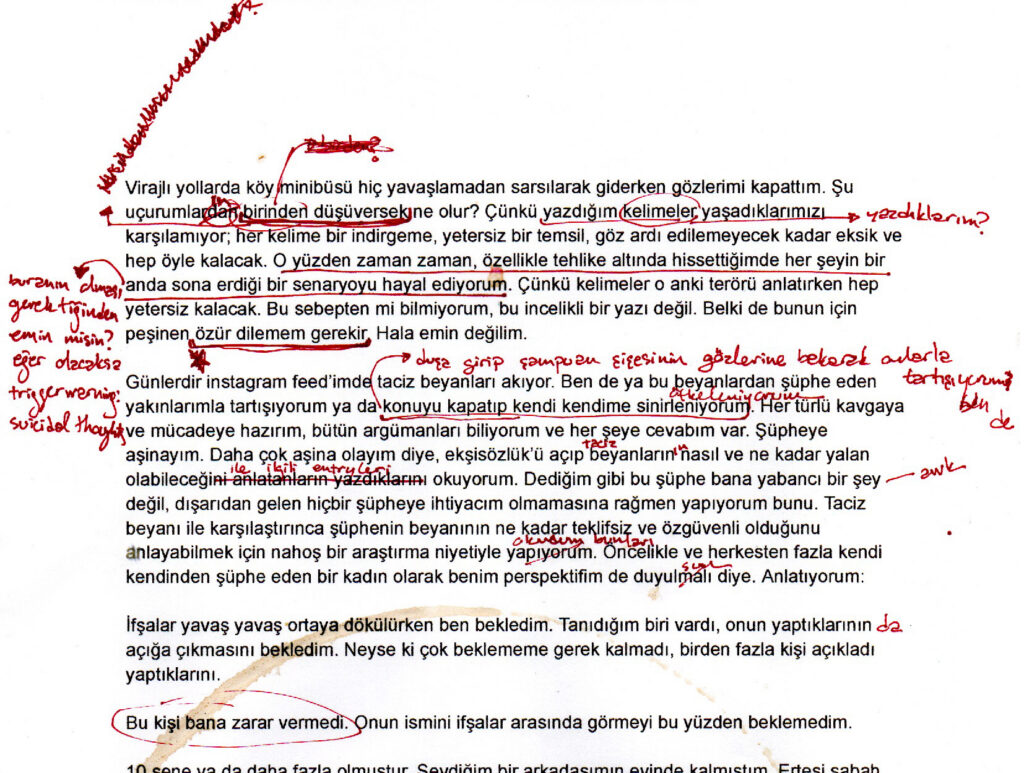
“While the village minibus rattled along the winding roads without slowing down, I closed my eyes. What would happen if we just tumbled off one of these cliffs, I wondered.”
I had met Leyla seven or eight years ago. We were in the same line of work; our interests and political views were similar. We bonded quickly. We went to concerts and the movies, trashed people we didn’t like, looked after each other’s cats and watered each other’s plants when one of us was on vacation, read each other’s writing. We weren’t besties who talked every single day, but we became the kind of reliable friends who show up when needed. I can say I know her well; I think she would say the same about me. We find good gifts for each other. If we go to a bar or café, we can order for each other. That’s why she must have known I would keep reading after those two sentences. Or perhaps, over the years, we grew into the kind of people who are curious about each other’s writing. Whatever the reason, there was no way I could return to what I was thinking about before reading it.
“…Because even now, however determined I am to write what I’m about to write — even though I’ve tried many times before, sat down to it again and again — it’s hard to write this; the words I choose don’t measure up to what we lived through; every word is a reduction, an inadequate representation, insufficient beyond disregard and bound to remain so. Sometimes, when I take on something I fear I cannot carry, I want to leave everything behind and take off. Most of the time, I don’t, and now too, this minibus will calmly take the bends and arrive where it’s supposed to, and life will go on. Like anyone who expresses herself through writing, I’ll do what I can, but words will always fail when it comes to describing lived terror. Perhaps that’s why I don’t care, this time, about the text’s literary quality — and why this is not a subtle piece of writing. Maybe I should apologize in advance for that. But I’m not even sure.”
It breaks my heart when women+ say they can’t write properly and apologize for it. Especially when they have decided to speak about being terrorized, about being subjected to violence. I’ve watched dozens of videos that begin with, “Sorry, I didn’t write this down / rehearse it / prepare it,” or “Please forgive me if I can’t find the right words,” and I’m tired of it. I’ve never encountered men apologizing because they speak English with an accent since it isn’t their first language, or because they misspell something trivial, or because they think they haven’t written something as good as before, or because they’re bad drivers. Just moments before Leyla’s message arrived, I had been in the middle of convincing myself not to apologize for the doctoral dissertation I left unfinished — I had only just found the courage to write about that — and now Leyla is apologizing in advance. It makes me feel as though everything I’ve struggled for, everything I’ve worked to earn, is gone. I wish people wouldn’t apologize unnecessarily.
“For days now, my Instagram feed has been flooded with testimonies of harassment. I argue, as much as I have the energy for, with people close to me who doubt these testimonies; when I’m exhausted, I close the subject — and when I’m alone, I rehearse responding to the things I’ve heard, or think I might hear one by one. ”
In those days, I did the same things. I fought with my mother, then with my boyfriend. I rushed away from people I couldn’t argue with, ran home, got into the shower, and argued with shampoo bottles while washing my hair. I answered, one by one, everything I imagined they would say. I couldn’t return to my work, couldn’t concentrate; I dreaded fulfilling some of my responsibilities, postponed others. Some days I survived on breakfast alone; however, one day, for instance, I sat down and ate a kilo of baklava. I never put my phone away.
“…I’m furious; I want to be ready for every fight and every struggle, to have an answer for everything.”
Every day, I picked up my phone expecting something to happen. I’m not sure what exactly. Each morning, I wondered who would dare to unmask whom, woke up curious about who my new enemy might be. Then, gradually, the testimonies slowed; little by little, we returned to the other things that usually occupy our agenda. I still don’t know where we directed our anger — perhaps in time it will find its way. But at the end of those terrible days, I admit I was relieved to be able to call certain people enemies without qualification.
“I’m familiar with doubt. To become even more familiar with it, I went on ekşisözlük and read the entries that deny the harassment testimonies. I read them with the unpleasant intention of studying how casual and self-assured doubt can be. Often in order to explain how a woman can doubt herself before anyone else does — and more fiercely than anyone else.”
During those days, I even confronted men who bumped into me by accident on the street, or whose eyes I felt on me in the minibus. Most recently, I argued with a man who said, “Ma’am, you seem to be struggling — shall we help?” while I was parking my car, “Ma’am, you’ve misunderstood!” he said later on. For the first time in my life, I think, I said: “No sir, I understood perfectly.”
“As the sexual harassment testimonies began to surface one by one, I waited. There was someone I knew. I waited for what he had done to be revealed. Fortunately I didn’t have to wait long; more than one person exposed him.
He didn’t harm me. That’s not why I wanted to see his name among the accusations.
It must be ten years ago, maybe more. I was staying at a close friend’s house. The next morning, after breakfast, she told me that this person — the one I had been waiting to see exposed — had told her ‘something very bizarre’ the other day. This ‘very bizarre thing’ was that he had had sex with a woman who was unconscious.
I don’t remember how the subject came up, or what was said in response. Which rapist recounts what he’s done saying, ‘You won’t believe what happened to me the other day’? I can only answer that now. But back then, I couldn’t.”
Almost all of them. Almost all of them see themselves as justified when they recount what they’ve done; they do not consider themselves guilty; they diminish the horror of it; they manufacture excuses. Almost all of them are misogynists. And when I say almost, I do not mean to suggest there is an exception among them. I say it only for form’s sake. Perhaps Leyla withheld her answer so that each of her readers would think the question through and offer their own. I am neither as polite nor as subtle as she is.
“A few years before that morning at my friend’s house, the same thing had happened to me. Someone I knew, someone I never thought would harm me — someone I believed was my friend — decided, on a night when I was very drunk, that he would sleep with me. I don’t remember him carrying me to my room, taking off my clothes, undressing himself and trying to enter me. I had already passed out. In the morning, he told me. And he asked plainly: ‘Did I rape you?’ I denied it without hesitation: ‘No, no, no — it takes two to tango.’
I continued seeing him, and later I had sex with him with consent. When I thought about that night, I always blamed myself for having been so drunk, thought that I must have tried to seduce him.
As the years passed, thinking this way exhausted me more and more. Whenever that night — or the word rape — came to mind, my hands would turn ice cold. I would immediately chase the thoughts away. To have lived through an experience in which my will and control over my own body were erased was maddening. I could not accept being a ‘rape victim.’ Instead, I comforted the man who raped me, kept sleeping with him, and told no one that I felt constantly anxious. I destroyed all the evidence myself. Then I cut my hair, wore loose, old, ugly clothes, and lashed out at anyone and everyone, deserving or not.
As difficult as it is to say you were assaulted, it is just as easy, once you say it, to hear that you are lying. People do not want to attribute harassment to someone they know and trust. Who would want to be friends with, to love, a rapist? I suppose — and these days I see — many people do. Because ignoring it, saying ‘she must have misunderstood,’ ‘she’s making it up,’ or ‘there are two sides to every story,’ is much easier than confronting it. The survivor hears it first from herself: ‘What if you misunderstood?’ ‘What if you seduced him, encouraged him?’ ‘He’s not like that.’ ‘He wouldn’t do something like that.’ Sometimes she is the first to voice the very things she hopes not to hear from others. That’s why, for instance, I never told anyone that the man I once loved more than anyone in the world slapped me because I didn’t want to perform oral sex, or that when I said to another, horrified, ‘What are you doing?’ he replied, ‘Oh — I thought you said let’s do it without a condom this time.’ Because when those things happened, I didn’t leave them immediately. And when I later left them for other reasons, I still told no one.”
I’m sorry. It breaks my heart that my friend has lived through these things. I love her and I don’t want to believe she’s been hurt. I almost find myself also saying, “Maybe she misunderstood.” I catch myself wishing she were lying rather than that these things truly happened to her. But it isn’t a lie. It’s all true. If anything, there’s less here than there should be — I’m sure of that. I’m furious. I know every person she’s talking about.
“Let’s go back to that morning: when my friend described a rape case to me as ‘something very bizarre,’ even if it wasn’t defined as rape at that moment, my body reacted the same way. Ice-cold hands and an overwhelming anxiety. I said, ‘Let’s not see this person anymore.’”
I don’t want them to walk around freely as if nothing happened. I want them to be unable to go outside, unable to attend meetings, unable to sit at anyone’s table in the bar we all go to and i want them to get kicked out, refused entry to the bus because the driver won’t let them on, left hungry because the delivery person saw their name and address and refused to bring over their food. I want them to dread going to the supermarket, to buy cigarettes, to drink a sip of water when they wake up thirsty at night. I want their mouths shut, unable to speak a word, their doors sealed; I want them to feel the ground slip away beneath them the moment they try to step outside; I want their electricity cut off, their plumbing broken, their heaters failing — until they wither away, slowly, between four walls, freezing. But none of this happens. We haven’t even demanded a single one of these things, yet. We said, “Let’s not see him,” and you won’t even accept that.
Anyway. At the same time, I feel proud of Leyla. Because we tried to survive not only in moments of explicit sexual threat or violence, but also while we were fake-laughing at stupid sexist jokes, or ignoring the bullying directed at us, or while speaking in a man’s voice so we wouldn’t stand out.
“At that time, I had many male friends. I don’t know why I thought I would be taken more seriously by playing along with men. That might be the cause of another kind of sadness, and the subject of another piece.”
I keep wondering whether Leyla, or I, or any of us who endured this kind of violence and then gaslit ourselves, would have been safer if we had surrounded ourselves more with women+ and queer individuals. What would my life have looked like if I hadn’t been the only woman at that table? If I had chosen to sit at tables with more women? Would I have asked for help when I needed it? Would I have confronted the abusers? Or at least ignored them less? Would I have called a small “joke,” a minor inconvenience, an isolated incident, what it so clearly was — misogyny, phobia — without qualification? Would I have laughed along with my male friends just to avoid being the spoilsport? Maybe I wouldn’t have been afraid of being excluded if we had formed a team of our own. I think about this constantly. If there had been more women in my life — more than I could want, more than I could count — would I have been so afraid of being alone?
“‘Let’s not see this person anymore.’ I don’t know how they reacted to that. They must not have taken it very seriously, because I also said, ‘Then don’t invite him when I’m around.’ I don’t remember how seriously they took that either. That man did not immediately disappear from my friends’ lives. At least not for that reason. From time to time, he showed up in places I didn’t want to see him and even asked me why I didn’t like him. Now years have passed and I still doubt myself: What if I misheard? What if I’ve convinced myself of a lie all these years? What if I lost my mind and made this up? Because if it were true, my friends should have been horrified too, right?”
They should have been — but they wouldn’t have been. The boys who pretend not to know what they know, who write long posts about how horrified they are when men they’ve spent years alongside are exposed as harassers — I watched them one by one. They wrote about confronting the perpetrators immediately, about cutting off ties, about how they could not believe they hadn’t seen it sooner. I didn’t believe a single one of them. If I’m going to doubt something, I’d rather doubt their sincerity.
“When, years later, I was finally able to admit to myself what had happened to me, I thought I would never doubt again. But it wasn’t like that at all. Even when I told my closest friends, I assumed they wouldn’t believe me — and each time I decided that if they didn’t, I would have to remove them from my life, and each time I was devastated. Each time I doubted on their behalf, too. What if I’m remembering it wrong? What if I’m inventing it? What if I misunderstood? What if I’m just a bitter, jealous woman slandering my exes? And then, in time, I began to say: whatever will happen, will happen.”
After speaking with the person who said she owed her dissertation to no one, I imagined a future for myself in which I possessed that same confidence. Nothing happens all at once. One step, then another — and before you know it, you’re arguing with men who say, “Ma’am, you seem to be struggling.”
“…Let them say whatever they want. Let them not believe me. Let me be the crazy one, a liar, a difficult woman. Whatever will happen, will happen. Let someone else be uncomfortable for once. I can’t say this constantly and carelessly, of course. I hope that by writing these things, I am sharing some of the burden I feel I’ve been carrying. But at the same time, I feel guilty for handing that burden to people who never volunteered to carry it. Will the apology I offered at the beginning be enough to release this guilt? I’m not sure about that either.”
In high school there was a group of boys who were always after me. For some reason they disliked me; they would shout behind me in the corridors, trip me as I walked. I ignored them. Most of the time they were harmless. But one day — I don’t even remember what happened — I was furious. That afternoon, while waiting for the bus, I imagined going very far away. I go home — thank God no one is there. I change quickly, pack a small suitcase, throw random things into it. I take my passport from the drawer. I leave without hesitation, take the metro to the airport. I pass through security. I go up to a counter and say, “When is the first flight to Marrakesh?” “In this many hours.” “And how much is a ticket?” “This much.” Fortunately, I have one of my mother’s bank cards with me. She gave it to me in case of an emergency. I withdraw exactly the amount they tell me from an ATM. By the time my mother notices and asks what I’ve done with the money, I’ll already be in Marrakesh. “Here you go,” I say. “This much.” “And here is your ticket.” My suitcase is small; I don’t check it. I pass through the second security control. I sit down at one of the cafés. “A beer, please.” It was a difficult day, after all. By evening, I’m in Marrakesh. No one asks for ID, but I’ve just turned eighteen — I’ll show it if necessary. They announce my name; I’ve drifted off somewhere and they ask me to come to gate whatever-number. I show my ticket and walk down the jet bridge. I sit in my seat. The plane takes off. I never come back. From now on, I’m Leyla from Marrakesh.
I have never been to Marrakesh. I did not leave school. The village minibus Leyla rode did not plunge off the cliff. We did not jump off the train between two stops. Because above all, we must protect ourselves. But just because we continued living does not mean we can deny the interruption, claim the line being drawn was never broken. How can I return to where I began? I can’t. Changes that leave no trace exist only on transcripts. The only thing I can do is acknowledge the interruption, emerge on the other side, and continue from where I stand.
“‘My dear Leyla, I’m devastated. But I suppose from now on, only a new order can be built. Thank you — I’m giving you an incomplete 🙂 I’ve added my comments. Call me tomorrow afternoon if you like.
kisses,
xx
leyla”
In her curatorial practice, Naz Kocadere explores the ways artistic expression takes shape in language and within relations of power. Here, she shifts her focus from words to the materiality...
read
In the series Experiments and Stumbles on Collaboration, İpek Çınar writes about how coming together and being "we" gets built —and where it falters— through the experience of running an...
read
Whistleblowing actions have transformed our perception of surveillance and control in today’s information society. This text examines the effects of whistleblowing as a form of dissent on politics, society, and...
read