A Superorganism Story or the Appetite of Matters
In the series Experiments and Stumbles on Collaboration, İpek Çınar writes about how coming together and being "we" gets built —and where it falters— through the experience of running an...
read
Zeynep Okyay


“Thinking with Concepts in Contemporary Art” has been supported as part of the SAHA Writing Series / Supported by SAHA Art Writing.
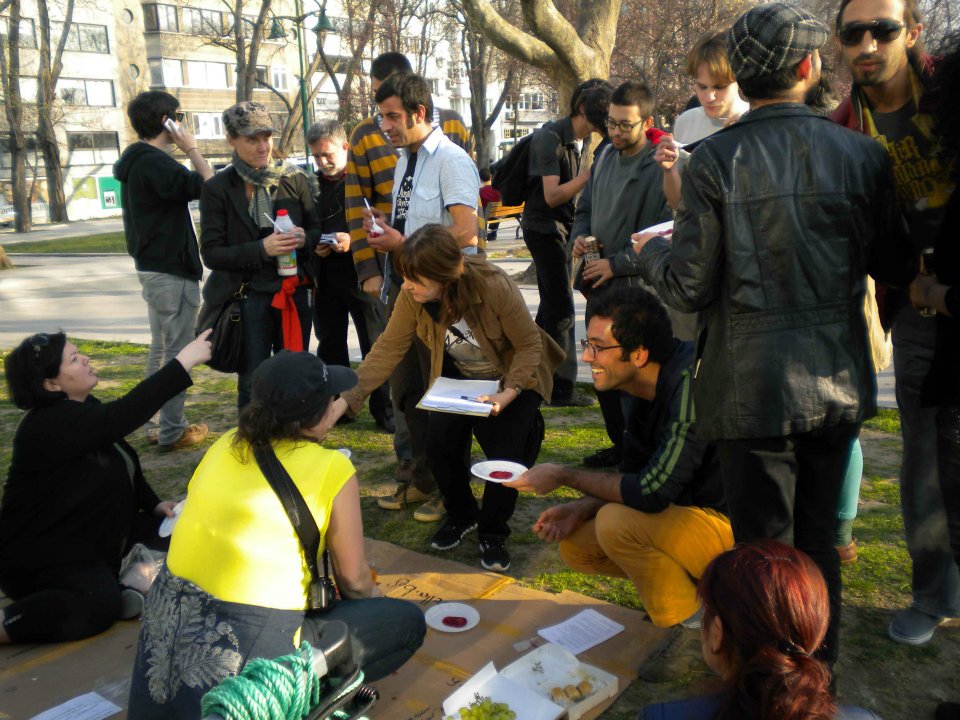
When we founded PASAJ in a small room in Halep Passage, we invited Funda Oral, who facilitates workshops on “collective decision-making practices”, to organize a gathering so that we could find a name for our space. Looking back, that first event says a great deal about PASAJ’s inviting, inclusive character. We were trying to come up with a name, but in fact we were searching for something else: how do you turn a space into the reflection of a shared idea?
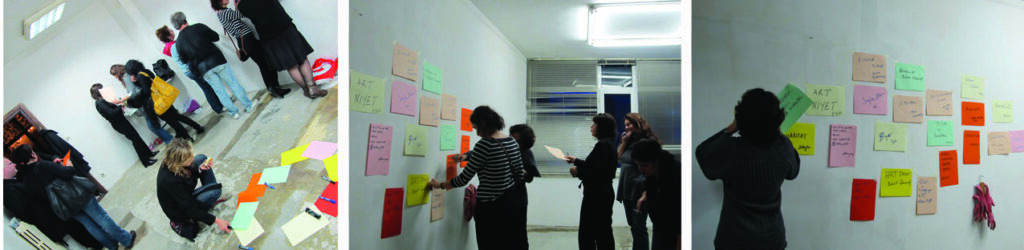
From the very first day we were founded, we questioned the concept of space itself. In the art field, space is often thought of alongside ownership. Having an address, having a door, having a sign are taken as measures of prestige. Yet the history of independent spaces is also, in part, a history of temporality. A history of borrowed rooms, empty shops, buildings slated for demolition. That is why we approached independence not as a fixed condition but as a becoming that must be continually reconstituted. We were founded, and we defined ourselves as an “independent art space.” Whether independence is even possible, from whom and why we wanted to be independent, and what this desire for independence was grounded in — these were questions that grew dense in our discussions and at times even settled at the center of our work. At the same time, as an entity anchored to a physical location, we always kept in mind another question: while a room makes us independent, does it also separate us from others? Is independence a form of separation, or another way of forming a relation?
We wanted to keep PASAJ independent even from its founders. We did not want it to be associated with any single person, artist, or space, so that it could become something that more people might find a place for themselves. Becoming anonymous could open the way for it to become others’ voices too. Only then could it take on a character beyond our own.
Being a collective is deeply complicated. Being a collective that works in a community-oriented way is even more so. While trying to open space for forming new relationships, learning together, and sharing experiences, a person also carries with them all their learned behavioral patterns, their modes of ownership, their hierarchies, their habits of taking the floor. Acknowledging these and letting them go is a long process. But when it becomes a practice repeated over and over again, it becomes possible to try other forms of being together.
In her text Hydrofeminism: Or, On Becoming a Body of Water, Astrida Neimanis describes water as a mode of becoming without fixed boundaries, existing in continuous relation with other bodies and other waters.[1] Water does not exist alone; it exists only by mixing with other waters, other bodies. A state of being that cannot be pinpointed to a single source, that is conductive, merging, changing direction, and recognizing no borders. This text makes me think of PASAJ. When we try to define PASAJ, we always run up against a similar difficulty. We say a space, it falls short. We say a community, it falls short again. It finds no full correspondence in definitions like program, artist network, or platform. The reason is that PASAJ exceeds the boundaries of those definitions and emerges through relationships. Like the water Neimanis describes, PASAJ takes shape not as a structure that stands alone and closes in on itself, but through encounters, collaborations, passages, and points of contact.
This relationality within PASAJ finds its most visible expression in participatory art practices. An idea emerges from one person, mingles with another’s thinking, becomes part of yet another encounter. As the actors multiply, authorship grows blurry. It passes through different bodies, takes different forms, and reconstitutes its own language each time anew. The idea of property operates through a desire for permanence. Yet in participatory art practices, the lifespan of a work is often brief; what endures is not the object but the encounter itself.
According to Neimanis, we are all wateries, and water will always be a little indeterminate, a little uncanny, a little difficult to comprehend. This discomfort with indeterminacy also manifests in discussions of ownership and representation within the art field. The art field is not open to equations with this many unknowns. It wants clarity. The defined. The categorizable. The low-risk. The on with a clear author, a clear owner, a clear representative. “Our artist. Our institution. Our space. Ours. We made it… It hadn’t been done before us.”
Must one always own? Why is ownership such a central issue in the art field? You will not find the answers to these questions in this essay. I don’t know the answers either. But not knowing is sometimes a good starting point. So let us not avoid this question. Let it accompany and unsettle us throughout this text.
This question extends not only to artworks but to the spaces in which they come into being. Participatory art practices depend on encounters, yet the public spaces in which encounters might take place are not always accessible. As gathering in public space in Istanbul grows increasingly difficult —in an environment where even assemblies of a certain size can be perceived as a potential protest— the spaces in which art circulates and forges new relationships often emerge in the zones that fall between the public and the private.
PASAJ has always been interested in semi-public and semi-private spaces. A building’s exterior facade, shared courtyards connecting two buildings, a corner of a restaurant, the back garden of an apartment block, or transitional zones that exist unnoticed within the fabric of everyday life can allow people to come together, share common areas, and experiment with different ways of living alongside one another.
PASAJ approaches these spaces not merely as physical voids but as a methodology and field of research for rethinking the public and reconstituting the conditions of participatory art. In PASAJ’s practice, space is not the backdrop to art production, but the direct subject of that production. Space is considered together with its memory, its users, its everyday rhythms, and its invisible relationships.
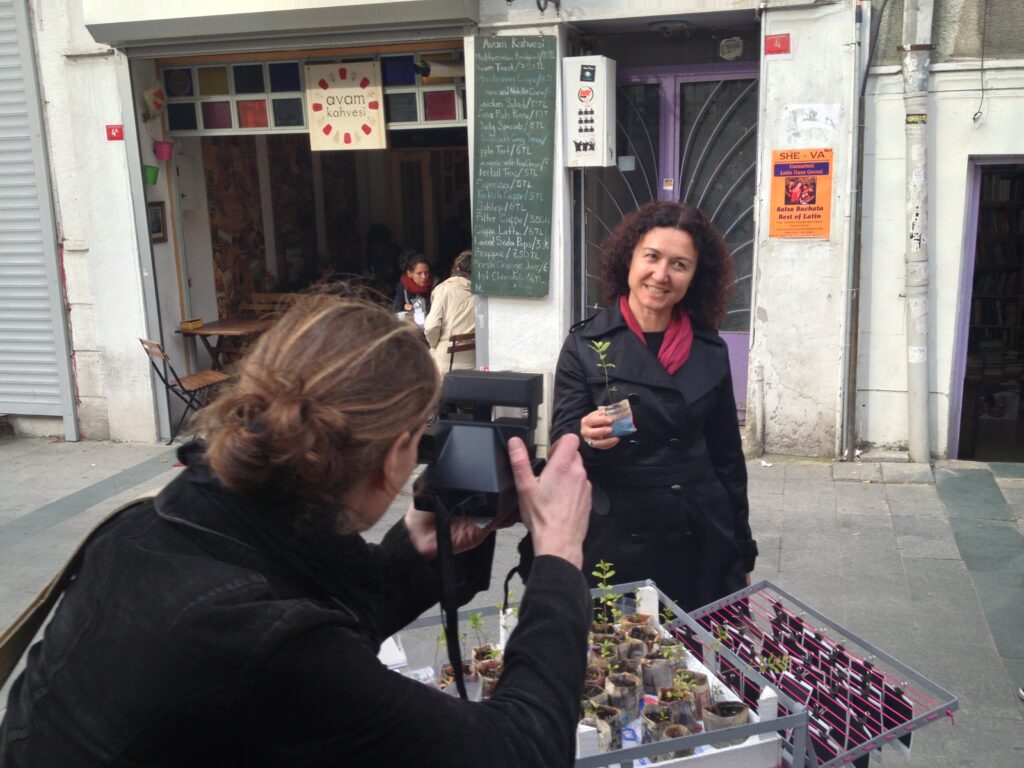
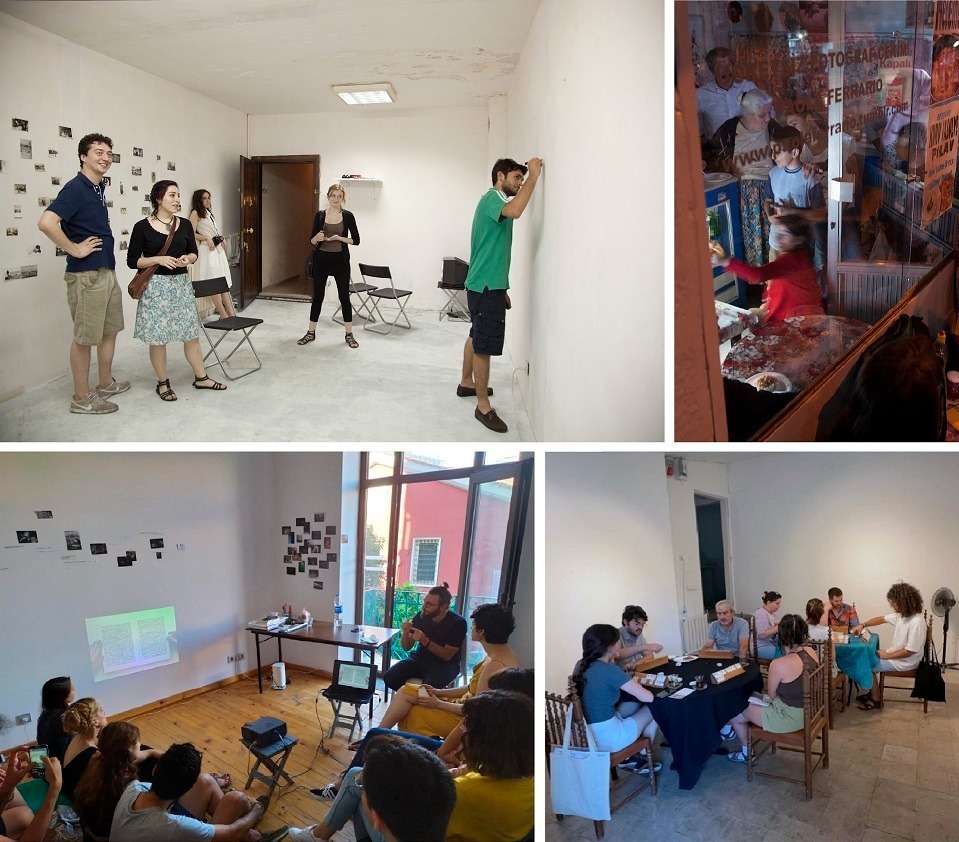
Anja Uhlig, Spitzbergen.nar.Project, 2013, Beyoğlu. Photo: Zeynep Okyay
rum46, Outsourced, dinner at Gezi Park, 2012. Photo: Elif Bursalı
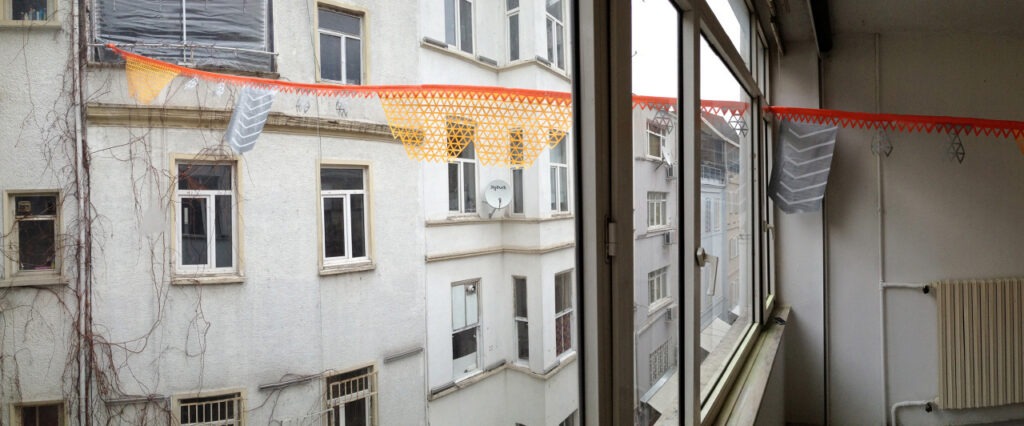
Olivia Valentine, Panorama, 2013, PASAJist. Photo: Olivia Valentine
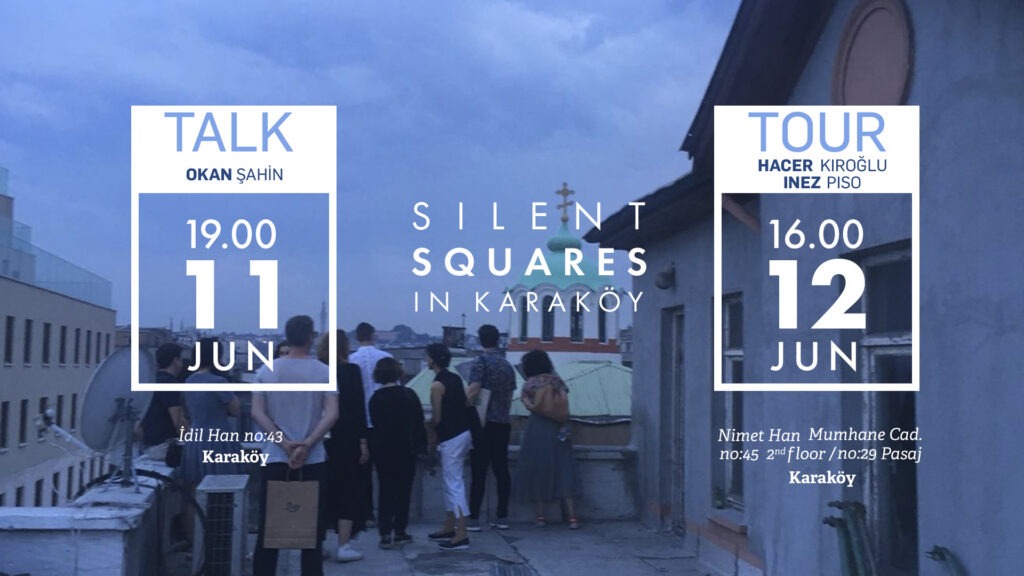
Hacer Kıroğlu, Silent Square in Karaköy, curated by Inez Piso, 2018, PASAJ Karaköy. Photo: Inez Piso
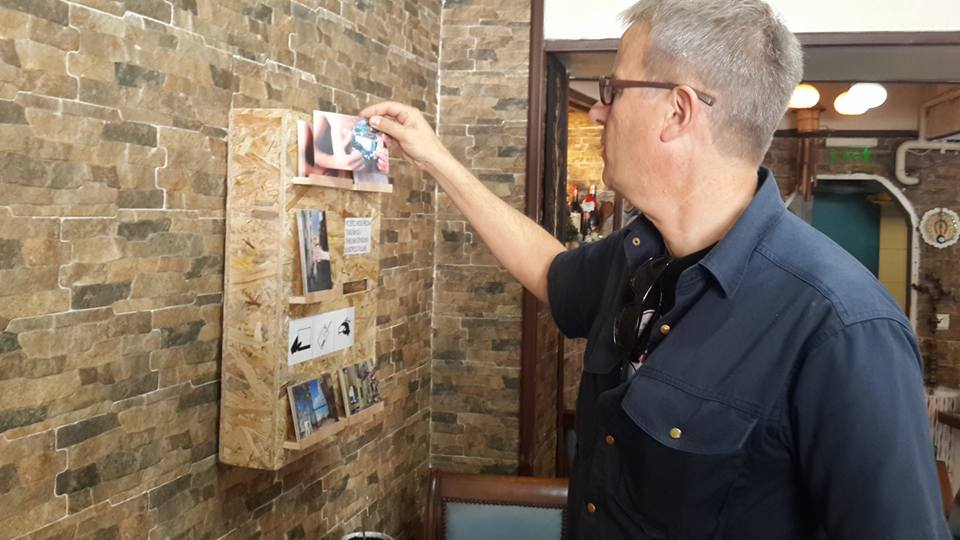
Giorgio Caione & Christian Oxenius, Postcards from Tarlabaşı, Saray Restaurant, Tarlabaşı, 2017. Photo: Giorgio Caione
Hacer Kıroğlu’s project Karaköy’de Sessiz Kare (Silent Square in Karaköy), curated by Inez Piso, investigated the sounds, the voids, and the invisible layers of a rapidly transforming neighborhood. Anja Uhlig, meanwhile, distributed pomegranate saplings from a handcart in front of Sainte Pulchérie High School, transforming the school’s everyday circulation into an artistic encounter. In the Postcards from Tarlabaşı project carried out in Tarlabaşı, alternative narratives were produced in opposition to dominant modes of representation concerning the neighborhood’s transformation; the postcards functioned not only as a means of communication but as a vehicle for entering into dialogue with residents and rendering local experience visible. Similarly, in the Outsourced project realized with the Danish art initiative rum46, the collective’s kitchen and exhibition space were reconstructed in cardboard and transported to Gezi Park, to universities, and to PASAJ; through meals, conversations, and exchange events, the spatial boundaries of cultural value production were called into question. In her exhibition Panorama, Olivia Valentine stretched a rope from the window of the room in Halep Passage to the balcony of the neighbor across the way and installed the lacework she had made from tarpaulin so that the entire back street could see it.
In PASAJ’s practice, support for artists is nourished not by predefined programs or institutional infrastructures, but by existing relationships and emergent possibilities. The aim is not simply to invite artists, but to work together toward creating the conditions in which they can experiment with new orientations in their own practice. PASAJ’s resources, an artist’s openness to experimentation, and the conditions life affords us come together to generate different formats and spaces. Sometimes this means being able to hold a residency once or twice a year at a hotel where one of the team members works; sometimes it means turning a space into a temporary studio during the period it is empty between exhibitions. In this way, the space ceases to be a fixed structure with a defined function and becomes a network of possibilities that is redefined according to artists’ needs, the course of projects, and the relationships formed. The support PASAJ offers takes shape precisely at this point: not so much through financial or institutional resources as through opening up working spaces, bringing different actors together, and creating new grounds on which art production can take place.
This approach also becomes apparent in the relationship PASAJ has built with spaces over the years. The initiative makes its presence felt not in spaces designed for art, but in places that are part of everyday use: İsmail’s restaurant, the storage room of Ot Café, a friend’s office, or a room in Barın Han are just a few of these. Sometimes a small room at the end of a corridor, sometimes a mezzanine in a han, sometimes a modest corner inside a restaurant becomes a temporary ground for art production and encounter. PASAJ never positioned itself in these spaces as a straightforward owner or tenant; instead it looked for ways to share existing spaces with others, to use them together, and to turn them into temporary commons.
Astrida Neimanis invites us to think of water as a commons. This perspective shifts the focus away from owning a place and toward the kinds of relationships we cultivate with it and with one another. The question is no longer what we can take, but what we can care for. The issue is not how much space we occupy, but how much space we are able to make for others.
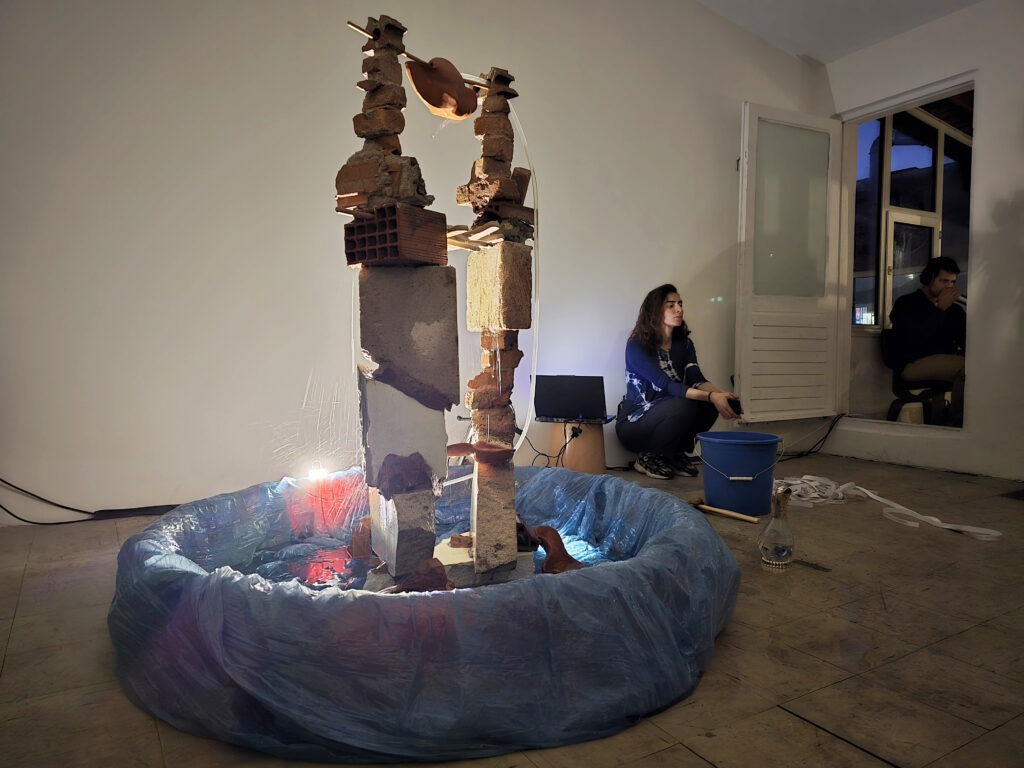
In 2013 we moved from Halep Passage to Tarlabaşı. The neighborhood was transforming rapidly. Before we began making art, we spent roughly a year and a half getting to know each other with our neighbors and building relationships. Before anything else, we tried to become part of that place. Because we believed that the first condition of working in a neighborhood was being present there. Later we began holding events in a small restaurant on Pazar Caddesi. This twelve-square-meter restaurant, run by İsmail Abi, became host to exhibitions sometimes or gatherings at some others. In this place whose primary function was a restaurant, people kept coming to eat, and everyday life kept flowing. The work that was made dissolved into that flow.
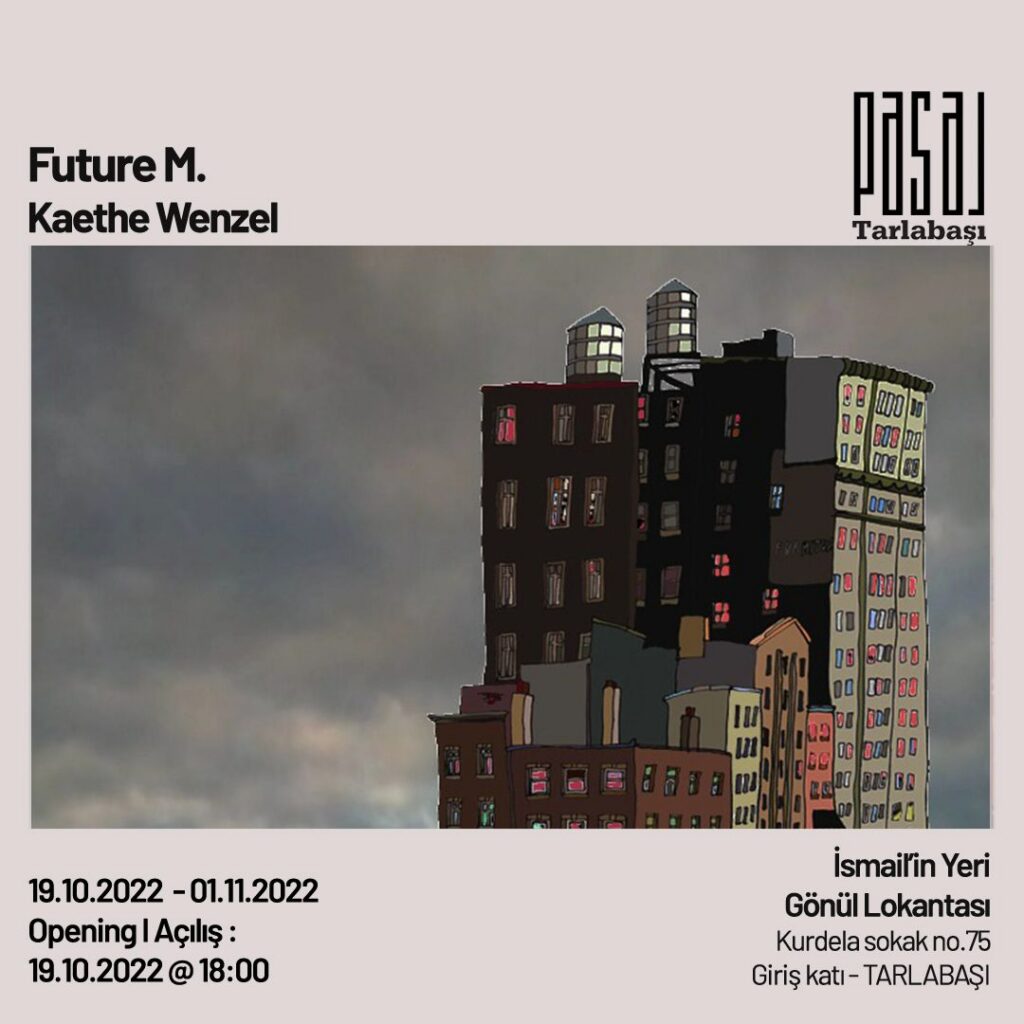
If you want to involve people in a project, you cannot see them merely as spectators; you have to create space for them. We experienced together what this means, in Tarlabaşı. Working together requires time, trust, and sometimes simply being present in the same place without doing anything at all. It requires thinking of the people involved in a project not as audience but as part of the relationship itself. The disappearance of a space does not mean the end of a relationship. Just as sustaining a relationship does not require staying in the same space. We continued to relate to many of the people we had worked with over the years. Throughout the Beyond Verbal project we maintained our connection with Tarlabaşı and with İsmail Abi; in the Sound of Curiosity READ project we again brought young people from Tarlabaşı into the work. Kaethe Wenzel’s project on the concept of home was realized and presented at İsmail Abi’s new place in Tarlabaşı.
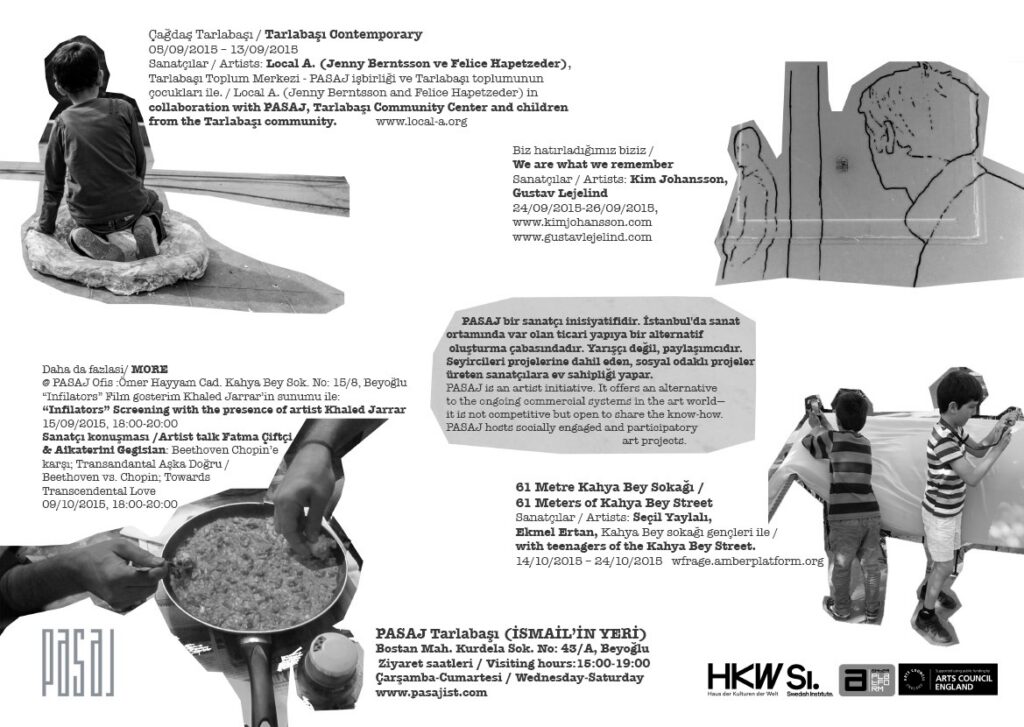
Astrida Neimanis writes: “As watery, we experience ourselves less as isolated entities, and more as oceanic eddies.”[2] I return to this sentence often. We are not isolated beings; we are eddies that form and dissolve within the same current. PASAJ’s story has moved something like this too. Through relationships that carried across from one neighborhood to another.
What draws us is not a new and empty space, but the possibility of becoming part of a structure that already has its own rhythm. PASAJ began in Halep Passage, continued in Tarlabaşı, and from there extended to Karaköy; today it goes on in a room on the 3.5th floor of Barın Han. Here we organize exhibitions, workshops, gatherings, and residency programs. But what interests us is, as it was years ago, still the same: to research the conditions through which people, spaces, and different experiences can come together through art. To take responsibility for something without owning it entirely. To leave something not quite finished. So that others, too, might have a hand in it.
Spaces change. People change. Neighborhoods change.
Some questions, though, stay with us.
[1] Neimanis, Astrida. “Hydrofeminism: Or, on becoming a body of water.” Undutiful daughters: Mobilizing future concepts, bodies and subjectivities in feminist thought and practice (2012): 96-115.
[2] Ibid.
In the series Experiments and Stumbles on Collaboration, İpek Çınar writes about how coming together and being "we" gets built —and where it falters— through the experience of running an...
read
Whistleblowing actions have transformed our perception of surveillance and control in today’s information society. This text examines the effects of whistleblowing as a form of dissent on politics, society, and...
read
When material sheds the instrumental approach of modernism and becomes a carrier of memory and knowledge, how does it speak to us? Starting from her family history extending to Northern...
read