The Right to Color
In her curatorial practice, Naz Kocadere explores the ways artistic expression takes shape in language and within relations of power. Here, she shifts her focus from words to the materiality...
read
Tatiana Bazzichelli


This text was first published in Tatiana Bazzichelli’s 2021 book Whistleblowing for Change: Exposing Systems of Power and Injustice, released by the independent academic publisher Transcript. The book is open access and can be downloaded or purchased from the website of the Disruption Network Lab, founded by Bazzichelli.
Whistleblowing for Change presents a critical perspective on both how to challenge power dynamics and how to expose societal injustices and wrongdoing. This book is an examination of the practice of whistleblowing in relation to cultural and artistic creation, which is a vital resource of inspiration for interventions that can generate political change.
The anthology is based on a conceptual connection between the stories of whistleblowers, investigative journalists, members of the hacker community, political activists and researchers, artists and critical thinkers in the field of information technology, politics and society. It presents multiple theoretical perspectives and direct experiences in crucial fields of investigation, thanks to diverse contributions from writers who have been central in inspiring and developing the activities of the Disruption Network Lab. By symbolically appropriating the term “disruption”—a notion traditionally used as a strategy of generating economic innovation—and bringing it into the context of political criticism, this book opens a new terrain of investigation into the framework of whistleblowing. Whistleblowing is presented as an act of “disruption”, which is able to provoke the unexpected within closed systems.
To make the idea of Whistleblowing for Change more accessible for readers, I will conceptually connect the beginning of this collective journey with my personal story, as many authors will do over the following pages.[1] Consequently, I will connect my individual perspective to the collaborative notion of whistleblowing, which is seen in this anthology as an act that is able to have an impact in and across cultures, politics, and societies, encouraging a mindset of exposing systems of power and injustice.
The theoretical reflections that follow come from my situated analysis of political and technological resistance in today’s information society. They do not necessary represent the view on whistleblowing and societal matters of the individual authors of this book, who have very diverse backgrounds and experiences. However, my aim is to examine this growing phenomenon, to offer interdisciplinary pathways to empower the public by investigating whistleblowing as a developing political practice that has the ability to provoke change from within.
Is Another World Possible?
Exactly twenty years ago, in the summer of 2001, I was highly engaged in the so-called hacker movement in Italy, and specifically in the underground culture in Rome. I was part of a collective group, AvANa (Avvisi Ai Naviganti), a former BBS-Bulletin Board System active since 1994 within the Social Centre “Forte Prenestino”, which was (and still is) a very important squatted community space for experimentation at the intersection of music, culture, political antagonism, social interventions, self-organisation and Do-It-Yourself production, but also art and hacking. Together with many people in the grassroots scene in Rome, and with the Strano Network group from Tuscany, I sought to connect the discourse of hacking with artistic practices, as a form of critical reinvention of technology and culture.
In 2001, while we were all politically active, socialising knowledge around free software, cyber-rights, and a collective dimension of hacking, our activities intertwined with the so-called no-global movement—although we considered ourselves to be global. We wanted to fight the new course that global capitalism was taking, often using highly creative methods. It was an important time for local and international grassroots media, with the creation of many independent radios, self-organised TVs, and online media, including Indymedia Italy, which shared the idea of providing information by ourselves and for ourselves. In 2001, there were intense discussions about creating a form of political opposition that was effective, because it was a moment of change, not only in terms of technology and society, but also in politics. It was also the time in which we all experienced something very difficult.
In July 2021, a large international event in Genoa and many local events in different cities commemorated the three days of protests that occurred over July 19–21, 2001 during the 27th G8 Summit, which was exactly twenty years ago. For three days in 2001, across Genoa, the movement suffered a great repression from the Italian police and “carabinieri”. Protester Carlo Giuliani was shot in Piazza Alimonda by a paramilitary police officer, and a brutal assault occurred inside the Pascoli-Diaz-Pertini school complex, where special unit Italian police irrupted and violently beat up many of the demonstrators who had been using the buildings as a dormitory and media centre. Around ninety of them were arrested and, after being transferred to the temporary Bolzaneto detention facility, many were tortured.[2] The issue of whether this was torture or not has been debated for years—in Italy at that time, torture was not recognised as a crime, and the investigations suffered a huge delay. It was not until April 2015 that the European
Court of Human Rights ruled that Italy had violated the European Convention on Human Rights during the G8 Summit of Genoa, with Italy passing a law making torture a crime in 2017, although the law’s definition of torture appears to still be too narrow.[3]
During the July 2001 G8 Summit I was not in Genoa, but in Florence with the Strano Network group. We were running an independent radio programme which informed the public about the demonstrations from a public square in Florence, connected live with Radio GAP (Global Audio Project), an independent network based at the Media Centre at the Diaz School, where other grassroots media platforms and the Genoa Social Forum were also temporarily housed.
We were working in collaboration with many other independent local radios in Italy, with the shared aim of documenting the G8 protests in Genoa. During the police irruption inside the Diaz School, we were connected live with Radio GAP. Thus, we experienced the police raid live, and it was a real shock. As soon as the police entered the building, the radio was forced to cut the live connection. There was a sense of hopelessness; we understood what was happening, we knew that it was a moment of violent repression and innocent people were suffering, and it was very difficult to cope with.[4]
In the days that followed, there was much discussion inside the Italian movement, while the press focused on the agenda of violence, on the sterile dichotomy of “good and bad protesters”, with the important points that brought us together in the fight becoming secondary. The consequences of the repression were hard to forget; trials went on for years, and many people left the movement. The impact was so strong that many groups decided to stop. But it was only an apparent end. Many others continued, and projects were created anew, inventing new tactics to think about politics and activism.
After the three days of Genoa, as we called them, I started an important ref lection of my own. I moved to Berlin in 2003, and became part of the city’s hacker and queer scene, trying to understand how to imagine a form of political opposition that was not just frontal, but more fluid. I was ref lecting on how to confront the enemy in a way that was not merely oppositional, how to not become the victim of it, and how to avoid ending up in situations from which there was no escape.
This is what happened in Genoa; the repression was orchestrated in a way that trapped the movement in a situation we could not escape from. We needed to find new strategies.
From Opposition to Disruption
In 2006, I wrote the book Networking: The Net as Artwork, related to the history of Italian hacking and media art, tracing a connection with the grassroots activities of social centres and activists. As a consequence of what I experienced in 2001, and the repression of Genoa, I started researching the concept of disruption as an art form. In 2008, as a PhD researcher at Aarhus University in Denmark, and later, as a Visiting Scholar at Stanford University, I came to rethink opposition in art activism, and in the business of social networking.
During these years, I also experienced another situation that totally changed my point of view, coinciding with the establishment of the so-called “social networking.” From the 1990s until today, I have considered the idea of networking to be creating a context for open interactions among people, and one in which people can experiment and create artworks by developing this context independently.
From the middle of the 2000s, networking became a business and the core interest of the network economy, transforming the idea of social relations into a commodity. The consequence of this was the progressive commercialisation of openness, Do-It-Yourself and hacker ethics by social media platforms and networking enterprises. Sharing values and business development became intertwined, generating a feedback loop that was instrumental to the development of users’ attention-based capitalism, despite the opposite intentions of many actors who had contributed to building up a free and open internet from the start. I felt that if we were just going to reject the business of social networking, we were going to fail. We had already failed many times before, in trying to oppose something that was clearly more powerful than us, with more resources and reach. My perspective became to imagine a critique that was not just a frontal opposition, but one that aimed to understand the inner logics of business, trying to change it from within. The outcome was the notion of Networked Disruption.
In the book Networked Disruption: Rethinking Oppositions in Art, Hacktivism and the Business of Social Networking (Aarhus University, 2013), I analysed the concept of disruption from a socio-political perspective, in relation to art and hacktivism. [5] The notion of disruption is appropriated from business culture to reflect on different modalities of producing criticism and, in a sense, to dismantle the constant process of appropriation that we experience (i.e. the counter-culture is taken over by businesses, the DIY culture is taken over by the network economy, a radical form of political criticism is appropriated by the opponents who adopt the same language but change its meaning, etc.).
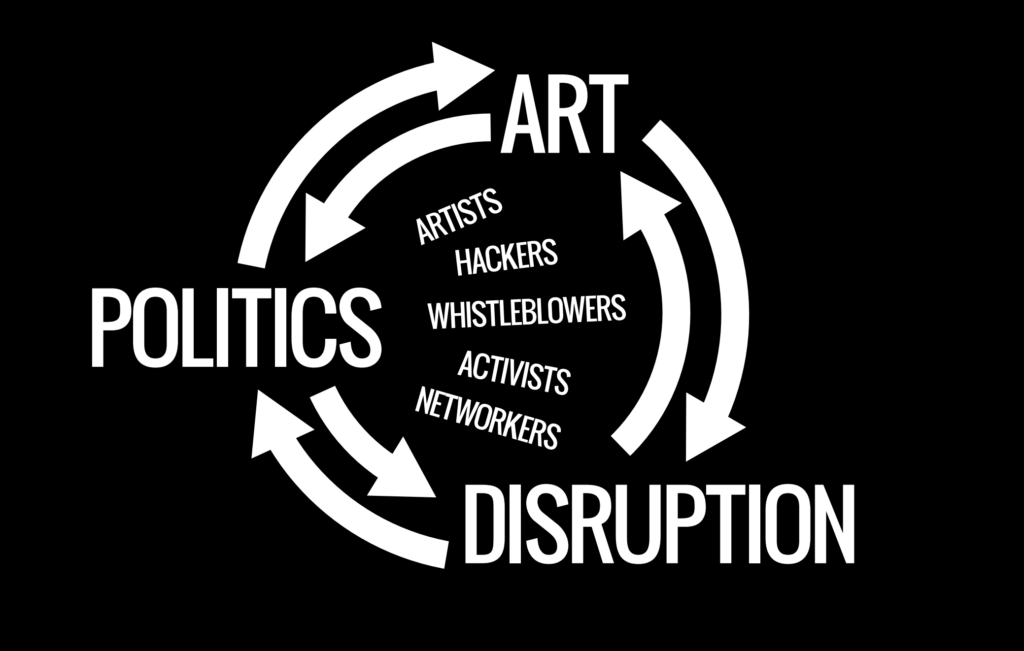
It is a feedback loop of constant appropriation, but how do we break this loop? In my theory of Networked Disruption (2011), I proposed to analyse critical practices that occurred through radical disruption of business logic instead of in opposition to it.
In the business world, disruption happens when an unexpected innovation is introduced into a market, displacing an earlier technology and producing new business values and behavioural tendencies. [6] Disruption is a concept that comes from business studies. It means to introduce something into the market that the market does not expect, and to provoke a perturbation inside a closed system.
Transferring the idea of business disruption to the field of art and activism, I imagined a speculative approach where disruption became a means to generate unexpected practices and interventions, which play within the business models of the media industry, and bend their limits. This conceptual shift arose from the need to find new activist strategies that are harder to appropriate and that go beyond the mere act of opposition, which might become a trap that reinforces power hierarchies.
Through a feedback-loop-model based on the co-existence of art, business development and their disruption, I proposed to bypass the classic power/contra-power dichotomy which often serves to indirectly legitimise the adversary, instead imagining new radical routes based on the act of provoking disruptive and subversive interventions from the inside of the media industry as an art and activist form. [7]
An earlier example of this concept could be the experience of Luther Blissett, a multiple-use name that was shared among various individuals between 1994 and 1999—first in Italy and then internationally. The “collective name” was created to expose how media businesses, and the construction of media stories, worked. The people involved in the Luther Blissett Project created fakes, media hoaxes, and unexpected events, to later reveal societal misconduct that needed to be exposed. The idea of subversion of the status quo through “collective situations” was central, even if Luther Blissett was never openly political; it was an experiment of applying the myth of a common cause. There was always a moment of realisation, questioning the meaning of the truth—and claiming responsibility under the name of Luther Blissett as a conclusion of the intervention. Later, we could conceptually connect the same discourse to the tactics adopted during the early phase of Anonymous. Anonymous represented the concept of disruption quite accurately, because it revealed the hidden logic and misconduct within society and the media industry and, at the same time, played with the concept of anonymity for facts that needed to be exposed.
Networked Disruption addresses both a methodology of business innovation (disruption as an economic model) and a methodology of generating criticism (disruption as a creative act of dissent). What these methodologies have in common is that they provoke a change from within. However, they operate within two different layers and have opposing scopes; the former feeds the business machine, and the latter deconstructs it to expose its limits.[8]
Following this speculative thread, Disrupting Business becomes a theoretical framework for artistic and hacktivist criticism to operate, and a media tactic where the logics of economic, political and technological systems are exposed. This is possible by first understanding how such systems work, and consequently stretching them to their limits, by imagining possible bugs and zones of intervention that function to provoke awareness, and to reveal malfunctions—a method of criticism that has been applied in the hacker scene for decades.
Networked Disruption can happen in the context of art, but also through political and social actions and other fields of technological experimentation. Instead of radically confronting business from an outside perspective that rarely exists, contributing to fuelling innovation through acts of dissent that are promptly appropriated, the scope becomes to analyse a disruptive feedback loop of innovation and its criticism, by studying its inner logics, identifying its contradictions, and subverting it from within. [9]
By further operating a symbolic appropriation of the term disruption as the radical act of generating criticism within closed systems, and transferring it to the contexts of whistleblowing and truth-telling, a new terrain of investigation and experimentation opens up. Disruption becomes a tactic to expose systems of power and injustice.
Whistleblowing: A Disruption from Within
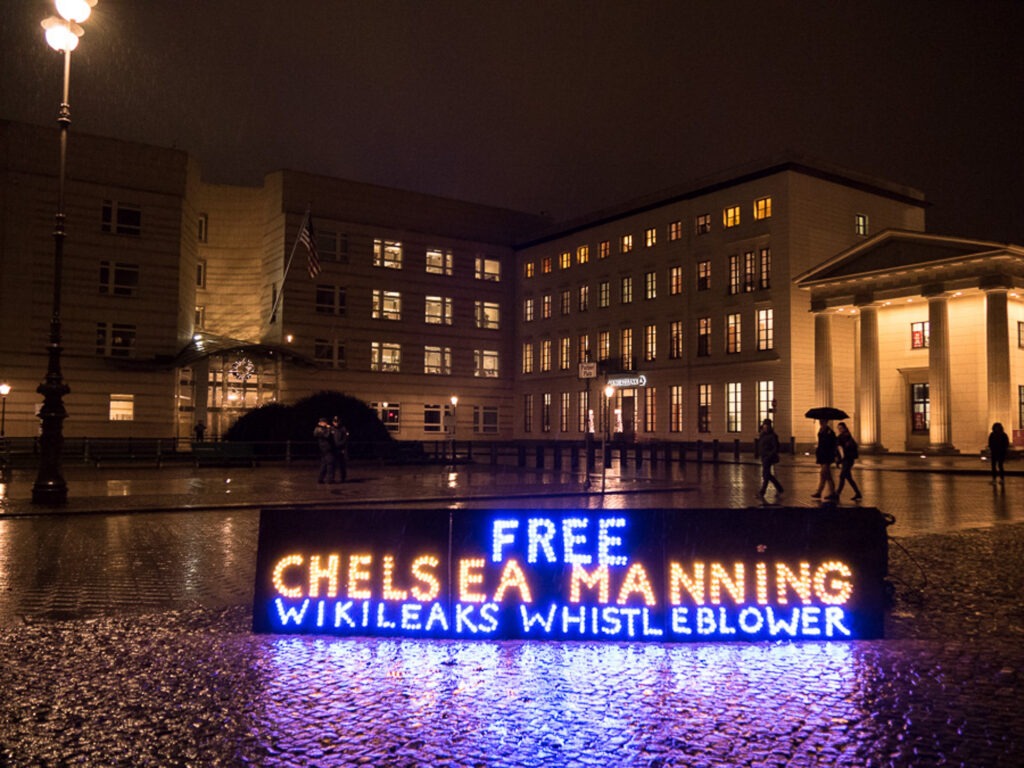
Around 2012 in Berlin, many people who were concerned with media culture, privacy, and social justice were beginning to become interested in whistleblowing. In 2013, we heard for the first time about Edward Snowden’s disclosures. Before then, we had read about the case of Chelsea Manning. And of course, we were following the WikiLeaks releases and discussing new methods of publishing stories as a collaborative and open effort.
For me, the encounter with this scene was crucial. In 2011, I started to work as a curator at the transmediale festival in Berlin and I was applying the analysis of artistic disruption as an experiment to shape part of the festival programme—combining the idea of curating and networking as a methodology for practice-based research.
If disruption is a form of criticism that works inside closed systems and tries to bring the unexpected from within the systems themselves, as well as aiming to change them, this is pretty much what a whistleblower does. Whistleblowing is a disruption that comes from within closed systems with the aim to open them up and to provoke a change. Usually, whistleblowers are deeply part of these systems; they work inside these structures, and very often they contribute to making them possible. But after witnessing wrongdoing and abuses, they decide to operate a radical mind change, and blow the whistle.
When I was working at transmediale as curator for the 2014 festival edition, I created a conference stream that was specifically about whistleblowing, and the connection between art and evidence—as described in my following chapter, and the interviews with Laura Poitras and Trevor Paglen. Before getting close to the whistleblowing scene, I had been looking at how to imagine art as a form of disruption that can interfere with business, and how we can imagine business as a form of disruption that can interfere with art. In the second phase of my research, which also connects to the foundation of the Disruption Network Lab in 2014, I applied the concept of disruption to whistleblowing.
How can we speak about disruption as a form of politics, both informing art and creating social change? How can we create a change that does not come from the outside, but from within the systems that we are dealing with? How can we analyse practices based on this co-existence of opposition, from one side belonging to the systems and from the other side undermining them? The focus is on practices by artists, hackers, activists, networkers and whistleblowers that create disruption within politically closed systems, and at the same time generate a change. By adopting a comparative approach conceptually (researching the mutual interferences between whistleblowing, information technology and disruption), but also shedding light on practices that generate unexpected consequences inside social, political and economic systems, we propose to analyse critical strategies in the framework of whistleblowing.
The objective becomes to explore the current transformation of political and technological opposition in times of increasing geopolitical surveillance, introducing disruptive methods of intervention. Disruption opens up a possibility of interfering with systems politically, technologically and artistically. This speculative theoretical approach is what informs this anthology and unites conceptually whistleblowers, hackers, artists, activists, advocates, journalists, and researchers. The goal is to encourage the exploration of critical models of thinking and understanding, and to analyse the wider effects of whistleblowing as an act of dissent on politics, society, and the arts.
Coming back to the first question I started with: is criticism only possible through opposition?
Is today’s populism co-opting the practice of disruption? Or can we respond critically to chaos and misinformation, generating disruption as a political strategy?
Disruption becomes a multifaceted concept to understanding how whistleblowing could inform social change. [10]
Exposing Systems of Power and Injustice
This anthology presents contributions about political, artistic and technological issues directly experienced and inspired by whistleblowers in order to open up a debate about whistleblowing to a broader public. As the challenge lies in exposing facts and wrongdoings that are hidden and non-accessible to the general public, whistleblowing is presented as a concrete act of change—a form of creative resistance from within systems—producing new forms of action as well as short-term and long-term effects in political, technological and cultural contexts.
Whistleblowing for Change is based on a conceptual montage of contributions by whistleblowers, investigative journalists, and members of the hacker and tech community, political activists, researchers, artists, and critical thinkers. It is a journey through multiple individual stories, practical and theoretical perspectives from writers and speakers who have been crucial in inspiring and developing the activities of the Disruption Network Lab. The majority of the writers have actively been part of the Disruption Network Lab’s programme, and some of them have even been in contact with me before April 2015, when the first conference of the Disruption Network Lab, “Drones: Eyes From a Distance”, took place in Berlin at Kunstquartier Bethanien. [11] Other contributors were suggested to me by some of the speakers that I initially approached, following an invisible line of mutual trust that goes back over ten years. As we will read in the short texts introducing the following thematic chapters, the association between the different contributions is speculative. It follows my specific theoretical perspective that connects a diversity of practices and approaches to explore new courses of action and investigation, as described in the chapter about the Disruption Network Lab’s methodology of building networks of trust.
It is very difficult to understand the deep meaning of whistleblowing without getting to personally know the people who have blown the whistle, or the wider community of activists, journalists, advocates, and researchers who work in this field. Although whistleblowing is often part of a dry and technical discourse, it relates intimately to the lives of the people who experience it, or work on it. This book seeks to bring these lives and this work closer to the readers and, therefore, many contributions are written as personal reflections or direct interviews. [12]
Whistleblowing for Change is also an opportunity to expose systems of power and injustice, which is our core motto at the Disruption Network Lab. The anthology offers a tentative proposal that whistleblowing is a source of change, connecting it with the idea of disruption from within—and imagining that, despite the fact that we are dealing with pervasive systems of power, change is still possible, and it depends upon the actions of us all. For this reason, Whistleblowing for Change brings together a montage of different approaches, about and by whistleblowers, but also by researchers, journalists, and activists that want to open closed systems.
In some contexts of law, politics, and society, whistleblowing is still targeted as a form of treason. This is seen not only in the context of releasing classified information, but also in the mindset that stigmatises such acts as something deplorable. The consequence is that in our society, whistleblowers are persecuted, disregarded, isolated, and strong measures are taken against them.
On the contrary, this anthology aims to make readers reflect on the importance of such a gesture. Exposing misconduct by speaking out against it is seen as a form of action that can improve our culture and society. In the book there are contributions from whistleblowers, but also from journalists working to expose misconduct and wrongdoing, alongside artists, researchers, and activists who share a similar approach in various fields of expertise. The challenge is to reflect on the impact of whistleblowing at a broader level, as a practice that can help to shape a better world.
I believe that whistleblowing should become a civil right. My hope is that by conceptually expanding this act to a various set of practices, it will contribute to making people who are heavily persecuted for speaking out more supported. Many of the authors who have been invited to take part in this collective work contribute to exposing systems of power and injustice, and often pay a high price for revealing the truth.
This anthology is a forum for creative inspiration on understanding how to make a difference in society. It is an invitation to dig deeper and keep fighting.
[1] This chapter elaborates upon the topics of previous workshops and lectures I gave across universities and institutions in the past years, and in particular expands on the transcription of my seminar: Tactics of Disruption Between Art, Hacktivism & Whistleblowing, which took place online at “The Horizontal Reading Group”, Akademie Schloss Solitude, on 12.5.2021. A special thanks goes to Alannah Travers for the first transcription of the seminar and to the Akademie Schloss Solitude for providing the video recording of my talk. A further version of this talk was prepared for the Interdisciplinary Summer School 2021, Trinity College Dublin, under the title Digital Culture & Digital Justice, on 1.7.2021, which contributed to deepen my most recent reflections on the interconnections between oppositional practices, disruption, and Whistleblowing.
[2] For a detailed reconstruction of the police violence and brutality during the 2001 G8 Summit in Genoa and the legal investigations related to it, check the website: https://www.supportolegale.org.
[3] See: https://www.reuters.com/article/us-italytorture-idUSKBN19Q2SQ, retrieved August 3, 2021.
[4] See the website (in Italian) where around midnight on July 21, 2001, Radio GAP documented the raid on the Diaz school live: https://processig8.net/Radio/radio_GAP.html.
[5] Bazzichelli, Tatiana, Networked Disruption: Rethinking Oppositions in Art, Hacktivism and the Business of Social Networking, (Aarhus: DARC Press, 2013), available online for free at https://networkingart.eu/2015/03/networkeddisruption.
[6] For a business analysis of disruptive innovation see the 1997 book by Clayton M. Christensen: The Innovator’s Dilemma: When new technologies cause great firms to fail, Boston, Massachusetts, USA: Harvard Business School Press. The book was inspired by the concept of the paradigm shift, introduced by philosopher of science Thomas Khun in his 1962 book Structure of Scientific Revolutions, Chicago: Chicago University Press, and then developed further by management consultant Dick Foster in his 1986 book Innovation: The Attacker’s Advantage, Mono, Ontario, Canada: Summit Books.
[7] See the graphic model in the introduction of the book, Bazzichelli, Tatiana, Networked Disruption: Rethinking Oppositions in Art, Hacktivism and the Business of Social Networking, (Aarhus: DARC Press, 2013), 10, also visible at https://www.disruptionlab.org/research.
[8] This conceptual model is based on the mutual interferences and feedback loops between art/activism, disruption and its criticism, rather than on the analysis of cyclical phases of appropriation and destruction operated by capitalism. It differs therefore from the Joseph Schumpeter’s 1942 “creative destruction”, readapted from the economy theory of Karl Marx and Friedrich Engels in The Communist Manifesto, where capitalism is cyclically revolutionising the means of production, by provoking a creative destruction of previous economic systems. In my analysis, disruption is not destruction, but an internal perturbation coming from the inside of closed systems.
[9] For a deeper analysis of disrupting business as a material of reinvention, see the book: Cox Geoff, Bazzichelli Tatiana, eds., Disrupting Business: Art & Activism in Times of Financial Crisis, New York: DATA browser 05, Autonomedia, 2013.
[10] To read more about the Disruptive Loop Diagram, and how disruption connects with the practice of whistleblowing, see also the interview with Lieke Ploeger and me, “Exposing Systems of Power and Injustice” by Bianca Herlo and Daniel Irrgang, in the context of the conference “Practicing Sovereignty” at the Weizenbaum Institute in Berlin: https://sovereignty. weizenbaum-institut.de/resources/aninterview-with-the-disruption-network-lab.
[11] The complete list of the Disruption Network Lab conference programme from April 2015 to today is available online at https://www.disruptionlab.org/conferences. The video documentation of the whole Disruption Network Lab’s events is available at https://www.youtube.com/c/DisruptionNetworkLab/videos.
[12] To preserve the personal style, background stories and experiences of the writers, the editorial decision for this anthology is to maintain the original (American or British) English spelling of the authors. We decided to uniform the book in British English but kept the original spelling for the American writers, if normally used in their writing. It is not an irrelevant choice for this book, if we consider the case of GCHQ whistleblower Katharine Gun in 2003, and the problem of the British English spelling correction at The Observer by a young journalist who, by turning the leaked top-secret memo from American to British English, almost undermined Gun’s act of whistleblowing about an illegal spying operation ordered by the US National Security Agency (as described in this article from the person at the centre of this “incident”: https://www.theguardian.com/film/2019/jul/27/international-incident-workmistake-official-secrets-film). On a personal note, we also want to show solidarity with the person who committed the mistake, and make clear that mistakes in this field are something to learn from; therefore we also need to value them and take care not to repeat them.
In her curatorial practice, Naz Kocadere explores the ways artistic expression takes shape in language and within relations of power. Here, she shifts her focus from words to the materiality...
read
In the series Experiments and Stumbles on Collaboration, İpek Çınar writes about how coming together and being "we" gets built —and where it falters— through the experience of running an...
read
When material sheds the instrumental approach of modernism and becomes a carrier of memory and knowledge, how does it speak to us? Starting from her family history extending to Northern...
read