
Landscape as Archive
In this text, Pelin Tan considers land and landscape as layered archives that carry the memories of human and more-than-human beings. Moving from walks through the Tigris basin to seed...
read
Naz Kocadere


In my curatorial practice, I have mostly approached artistic expression through language. Through exhibitions, publications, and research projects, I have worked on writing systems, censorship, multilingualism, collective memory, cultural belonging, material culture, forms of more-than-human communication, archives, and the canon. Some of the questions that have repeatedly emerged in the course of this work have been how expression emerges through different channels and how it gains visibility within relations of power. In this text, while continuing along the same line of inquiry, I want to shift the focus from the systems that constitute language to the materiality of color. My starting point is the idea that expression is produced not only through words, but also through materials, pigments, and the historical layers they carry. Pigment is the material carrier of color. It can have a geological, botanical, animal, or synthetic origin. Color, meanwhile, extends into the experiences produced by this material carrier in perception, memory, and culture.
Therefore, the story of a color does not actually begin with the color visible to the eye. The extraction of a mineral, the cultivation of a plant, the collecting of an insect, the processing of a pigment, its transportation to another geography through a trade network, the transmission or disappearance of a form of production knowledge, and finally its becoming visible on a surface can all be thought of, in a sense, as parts of the history of a color. Thinking of pigment not only as a raw material for aesthetic production, but as a geological, ecological, economic, and political material also reveals the network of relations that remains invisible behind color. The production of a color can stretch from mineral extraction to plants, insects, labor, trade routes, histories of colonialism, and environmental destruction. At the same time, we cannot think of this material past separately from the traces color leaves in human memory and sensory experience.
I want to begin, first of all, by looking at the history of naming colors. At the root of many words that we perceive today simply as colors, there is actually a plant, insect, mineral, fabric, or other object that carries that color. Most of the time, the name of a color is originally the name of the thing that produced or carried that color, rather than the name of the color itself. Naturally, throughout history, different languages and different cultures have established these relationships in different ways. Following the etymology of a color word, therefore, is not simply a linguistic curiosity. It also means tracing the relationships people have established with materials, geographies, and modes of production.
Rather than separating art history from the history of pigments and coloring materials, I find it quite fascinating to examine how art, chemistry, technology, and trade have transformed one another. The colors an artist uses in their works are never merely an aesthetic choice. They are also connected to where a particular material can be found, how it is produced, how expensive it is, and through which trade routes it circulates. Seen this way, pigment ceases to be a neutral “raw material” that exists outside the artwork and becomes an entity with its own history, geography, and political economy. [1]
The series Renk Üstüne Sohbetler (Conversations on Color)[2] by graphic design trained artist Gizem Hız, archived on Manifold since 2021, has been one of the important sources for me along this line of thought. In particular, the episodes on the production of natural pigments, colors derived from plants, printing processes, photography, architecture, and the treatment of color as sensory data offer a wonderful archive for thinking about the material and cultural dimensions of color together. Although, in order not to make the content of this text even broader, I cannot touch on some of the topics, such as natural plant-based dye practices developed with food cooperatives[3] and the relationship between the color white, emptiness, and artists’ books[4], I strongly recommend that you, the readers, take a look at them.
Another discussion that emerged in the course of this research is that color is not only a material richness, but also a field that has been suppressed, classified, and hierarchized throughout history. For example, in the early 2000s, the suspicion of corruption or contamination stemming from color that has existed in Western culture since antiquity entered the literature under the name “chromophobia.” The writer Batchelor[5] argues that color has often been associated with what is foreign, feminine, Oriental, primitive, childish, or vulgar, and has thus been pushed outside the realm of “high” culture. At this point, the relationship between color and “bad taste” also becomes important. Aesthetic categories such as kitsch or camp cannot simply be defined in terms of tastelessness. They also make visible how class distinctions, cultural hierarchies, and patterns of consumption are turned into forms of taste.[6] The concept of kitsch, in particular, which came to be used to describe the cheap, mass-produced, exaggerated, and imitative aesthetic forms that emerged after the Industrial Revolution in the nineteenth century, invites us to consider just how class-based the distinction between “good” and “bad” taste actually is. Color is an important part of this distinction too: vibrancy, flamboyance, and excess are often coded as “tasteless,” while restraint and simplicity are associated with a more refined taste.
In this sense, color is seen either as something dangerous and uncontrollable, or as something superficial and secondary, merely decorative. This double positioning suggests that color is not simply an aesthetic choice, but an issue that acquires meaning within cultural and class hierarchies. After all, you have probably noticed that our everyday surroundings have increasingly moved toward a more neutral and monotonous palette. In his article drawing attention to this issue,[7] David Speed considers it not simply as a design trend, but as a continuation of the historical aesthetic and social value judgments that have been constructed around color. It is thought-provoking to consider that the suppression of color may not simply be a visual preference, but part of a broader cultural issue connected to what is accepted as refined, serious, desirable, or “good taste.”
Moreover, a contradiction emerges here within modernity itself. When we consider the association of certain colors with professionalism, seriousness, and industrial progress after the Industrial Revolution, as well as the way the use of color was reorganized within particular hierarchies in modernist aesthetics, we cannot read color’s relationship with modernity simply through the “loss of color.” Perhaps the issue is less the disappearance of color than which colors, at what time, and by whom are considered acceptable. This question leads us to think of color not only as a perceptual or aesthetic experience, but also as a category shaped by relations of class, culture, and power.
All of this helps clarify the question: Could the history of modernity really also be the history of the loss of color? Of course, this is not a yes-or-no question, and perhaps it could even be considered rhetorical. In fact, it may be more accurate to ask how modernity has reorganized color. On the one hand, color has been suppressed, simplified, and associated with what is “tasteless” or “childish.” On the other hand, modern chemistry and industry produced new pigments that had not previously been possible, standardized color, and put it into circulation on a mass scale. The issue, then, is not simply the disappearance of color, but the question of which colors are produced, which are valued, which are standardized, and who has the right to use these colors.
From here, I want to move on to a somewhat unusual text that points toward how pigments circulated across trade routes, languages, and geographies as I look into the material and everyday history of Turkey. In his article examining indigo, which entered homes in the form of a small blue lump and was used to whiten laundry during the early Republican period, researcher and writer Gökhan Akçura,[8] who also wears many other hats across different interdisciplinary fields, reminds us that this pigment essentially comes from two different plants: woad (Isatis tinctoria) and indigo (Indigofera tinctoria). Woad belongs to the mustard family, while indigo belongs to the legume family. But woad is identified with indigo because the defining quality of indigo is its ability to produce the strongest blue. Its history, meanwhile, is deeply intertwined with India, trade, and colonialism. With known uses dating back to the 700s BCE, indigo was used for centuries as a valuable dye because of its strong and lasting blue, and was transported from India to Europe by Portuguese, English, and Dutch merchants. The history of a single pigment reveals the relationships between agriculture, labor, trade, and colonialism. The traces of this circulation in the Ottoman geography are also striking. A study on the economic history of Gaziantep discusses indigo as one of the main natural dyes used in dyehouses, noting that indigo, particularly the indigo grown in Lahore, was imported from India and Yemen and was a costly raw material that was traded.
Thus, pigment is not only a material of production, but also part of everyday life and cultural memory. Following the circulation of a color allows us to see not only where it came from, but also who used it, how it was given new meanings, and how it was forgotten over time. From here, we can move from the circulation of pigment to the question of who can claim ownership of it: When does color become an object of property? Is producing a pigment, giving it a name, or branding it enough to claim rights over it?
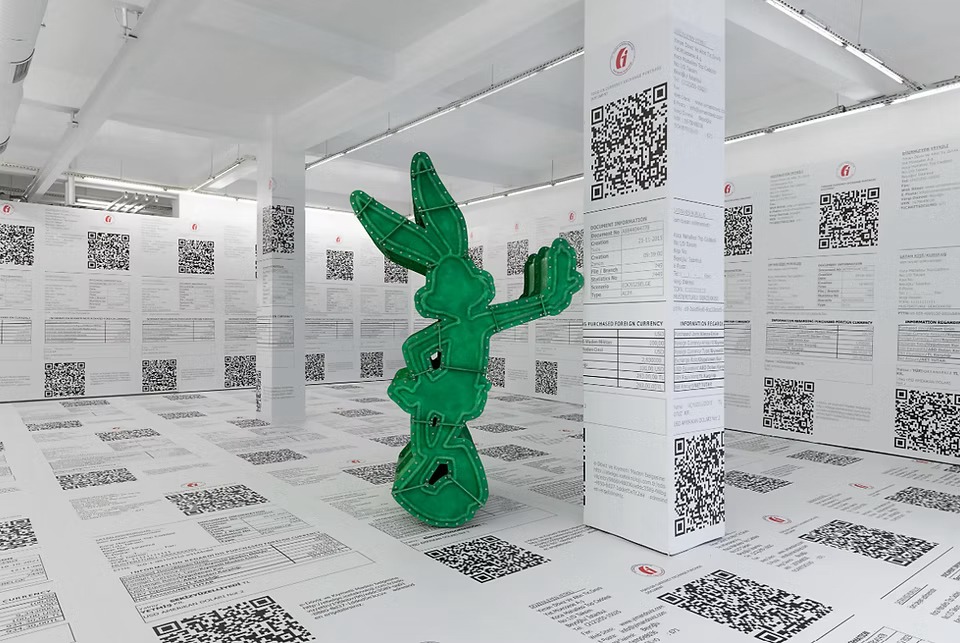
Color can become not only something that circulates, but also something that can be claimed as property. For example, Yves Klein’s International Klein Blue[9] and Anish Kapoor’s exclusive rights to use Vantablack[10] show that color can be named and branded within the field of art and brought into relations of ownership. But color is not only something that is claimed as property, it can also be symbolically reinterpreted. İrem Günaydın’s Fourth Bunny[11] (2025), from the exhibition About the Artist, is a contemporary example of this: a gigantic Bugs Bunny figure painted toxic green uses color not so much in relation to the history of a particular pigment as a warning sign. Appearing in the midst of a decaying system, financial disaster, and systematic forgetfulness, this green makes panic and danger visible, showing how color can become a political language.
Here, the material and the symbolic are not separated from one another. The physical properties of the pigment, the cultural meanings of color, and the symbolic value attributed to it by the artist meet on the same surface. In Aslı Çavuşoğlu’s Red / Red (2015) work, the red obtained from the “Ararat” or “Armenian cochineal” (Porphyrophora hamelii) insect is associated with the contested border geography that separates the two banks of the Aras River. The production knowledge of this red, which has been used for centuries in textiles, frescoes, and manuscripts, has been largely lost on the Turkish side since 1915. The pigment used in the project, meanwhile, is derived from ink reproduced by a researcher in Yerevan based on recipes found in fourteenth-century Armenian manuscripts. In this way, Çavuşoğlu places side by side the different histories that have developed on either side of a single color: on the Turkish side, the red of the Armenian cochineal has been replaced by the red of the Turkish flag, while on the Armenian side, this ecosystem is gradually disappearing. Here, color becomes both a material remnant and a political language read through borders, memory, and loss.
A similar relationship can also be seen in Al-Wah’at Collective’s Wild Hedges (2023), which could be seen in the exhibition Breaking Through a Dam[12] at SALT Beyoğlu in recent months. Tracing the circulation of prickly pear and scale bug between Palestine, Mexico, and Spain, the project considers the ecological history of these living beings together with colonialism, dispossession, and forms of other-than-human life. Its focus on the plant’s and insect’s different material uses in weaving, dyeing, printing, and food shows that pigment does not only produce a color; it also carries the soil, labor, and relations between different geographies. Otobong Nkanga’s practice, meanwhile, which traces the relationships between minerals, extraction, and labor, expands this line of inquiry: the material behind a color can point to a geological and political history far broader than the color we see on the surface.
On the other hand, the way color is experienced bodily and sensorially is as important as the material history of pigment. In Jeffrey Moore’s novel The Memory Artists (2001)[13], that I read with great pleasure years ago, the synesthetic character Noel Burun experiences words as colors and forms, which made me think about how memory can be formed not only through language, but also through relationships between the senses. Here, I choose to consider the novel not as scientific evidence, but as a literary example through which to think about the permeability of the boundaries between the senses. On the other hand, the relationships that the twentieth-century painter Wassily Kandinsky established between color, sound, and movement were groundbreaking. Kandinsky approached color not merely as an optical element, but as a multisensory experience connected to spiritual and auditory vibrations. Placing this intersensory approach alongside the material history of pigments brings together the bodily experience of a color and the history of the material that makes that color possible. Can a color be, at the same time, both the material result of a mineral, plant, or synthetic compound and an experience formed within the body, memory, and culture?
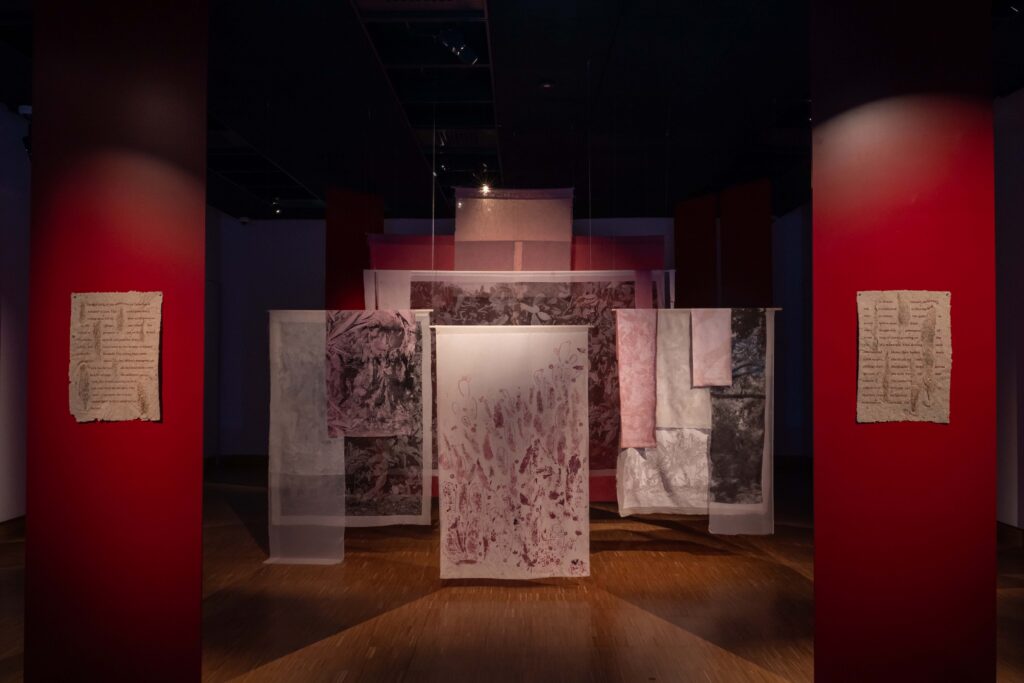
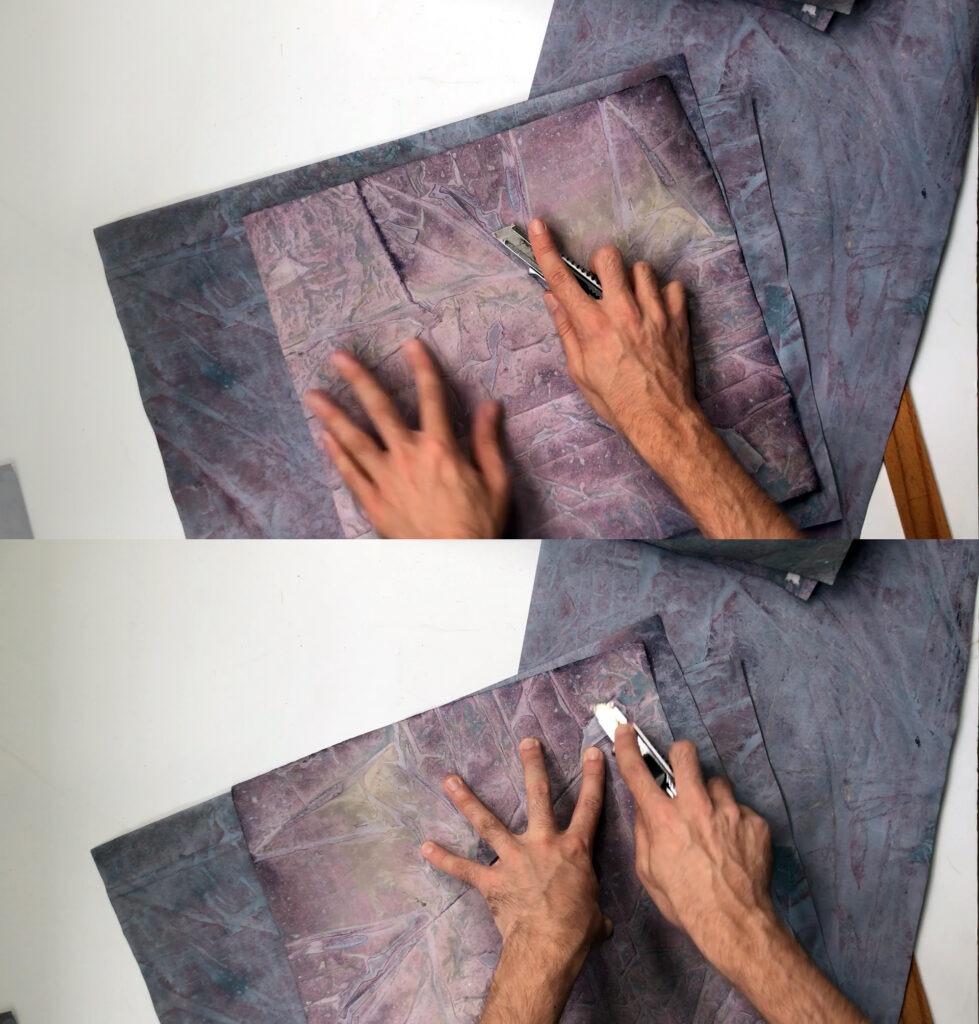
This question leads me to the ways color can carry personal and collective memory. How might it be possible to trace the memory of a place, or to keep someone else’s archive alive, through color? I think we can consider the recent work of artist Furkan Öztekin in this context. Since 2019, Öztekin[14] has been working with the archive of the deceased trans poet and activist Ceyhan Fırat. In the series Yepyeni Gözler (Brand New Eyes), he brings the accidental traces of color that form on the backs of photographs and sheets of paper back onto the surface using ink, acrylic, and charcoal.
At the center of these works is the expression “shabby pink,” which Fırat uses to describe the sky in her autobiographical book Bacak Böcek Oyunu (1996). Öztekin does not simply remember this color, but follows its trace through mixtures of ink, charcoal, and acrylic. The resulting stains become both a color investigation open to chance and an attempt to reconstruct something that is no longer present in the archive. In this way, color becomes less a means of representing the past than a way of relating to it, while “shabby pink” transforms from a memory into a tangible trace of a search for a shared language and memory.
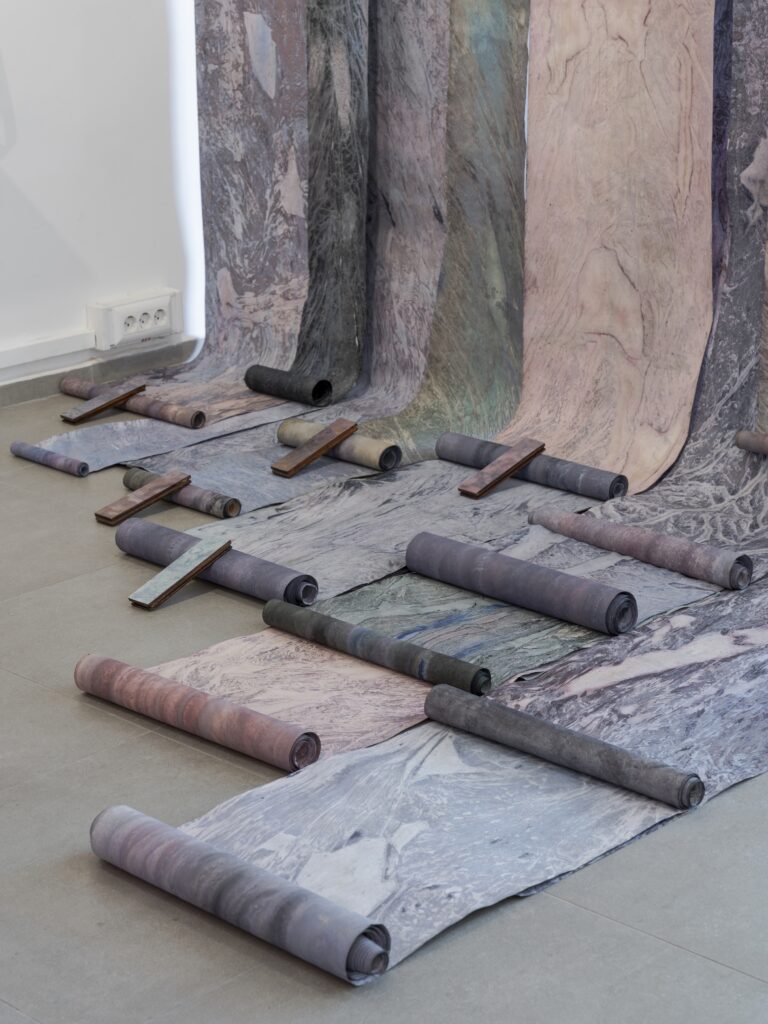
Furkan Öztekin, Brand New Eyes, Installation, 2026, Photograph Kayhan Kaygusuz & SAHA Studio
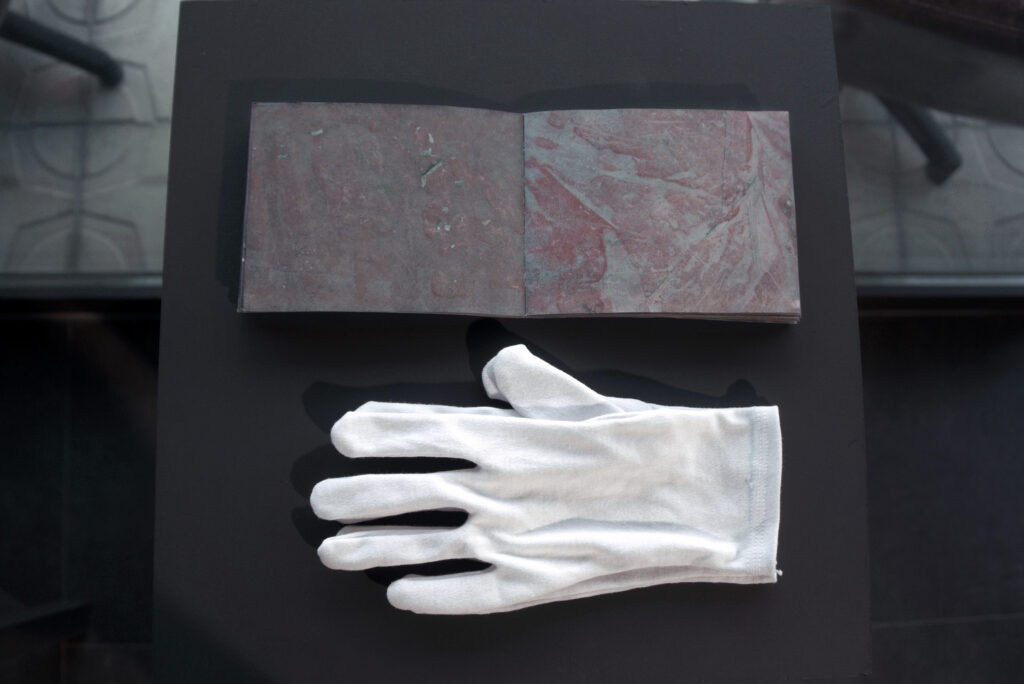
Furkan Öztekin, Notebook, 12 x 16 cm, 2022
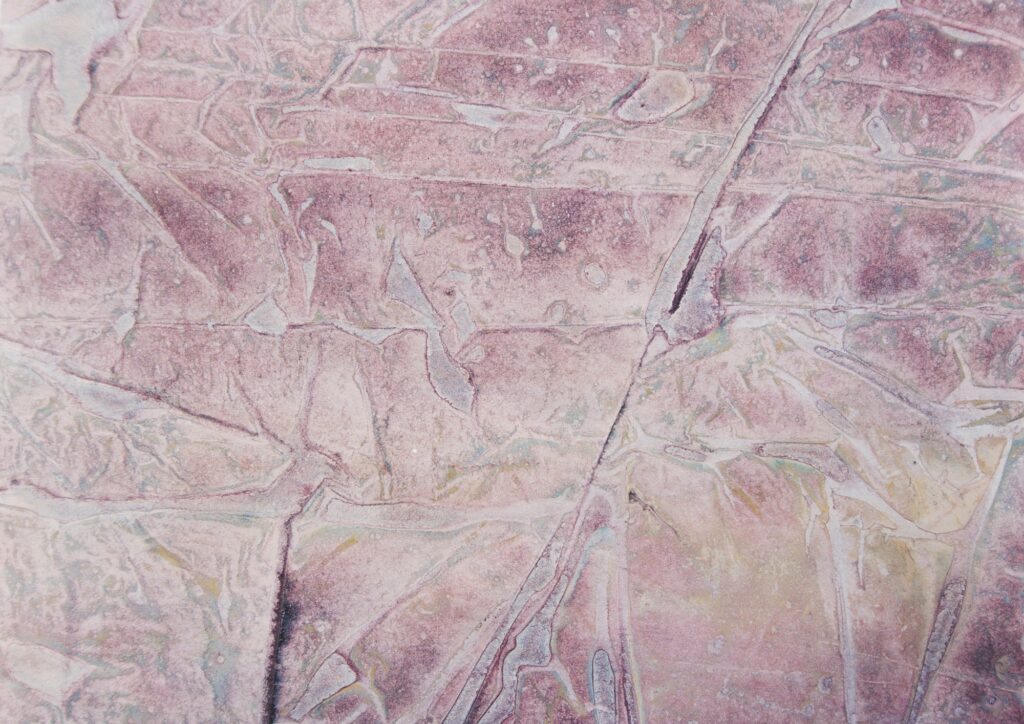
Furkan Öztekin, Brand New Eyes, Ink, Charcoal and Acrylic on Paper, 2020–2023
Furkan Öztekin, Brand New Eyes, Color HD Video, 2022
The capacity of color to reconstruct an archive, trace a space that is disappearing, or preserve the memory of suppressed identities in this way also brings the political meanings of color into question. The strong relationship that purple has established with the feminist movement, or its uses in LGBTQ+ history, shows that a color can become a carrier of social struggles over time. Mor Çatı’s use of purple as one of the symbols of the feminist struggle in Turkey since 1990 reminds us that color can be not only an aesthetic or sensory experience, but also a space of collective political memory. At this point, the practice of artist Müge Yılmaz, whom I will discuss later and whose work is informed by feminist science fiction, opens up another line for thinking about these relationships between color, the body, identity, and belonging. I am adding new questions: Can a color recreate a personal archive just as much as it carries the history of a historical material? Can it preserve the traces of a place or an exiled identity? Can the meaning of a color change together with the experiences of the communities that use it?
These questions lead me, in the final section of the text, to the color turquoise. I think turquoise is a powerful example of how complex the relationship between color and material, material and geography, geography and language can be. While blue and the color of the sky were associated with sacred concepts such as eternity, the sky, and the east among the early Turks, the visual presence of blue-green tones is striking in the tiles of mosques, madrasas, and tombs during the Seljuk and Ottoman periods. The transportation of turquoise stones from Asia to Europe by Turkish merchants shows that this color and material have not only a cultural meaning, but also a history of circulation. Indeed, the name turquoise in European languages is thought to be connected to the stone reaching Europe through the geography of Turkey. Yet the geological origin of the stone and the geography indicated by the name given to it do not point to the same place. Here, the name may be recording not so much the origin of the material as the route through which Europe came to know it.
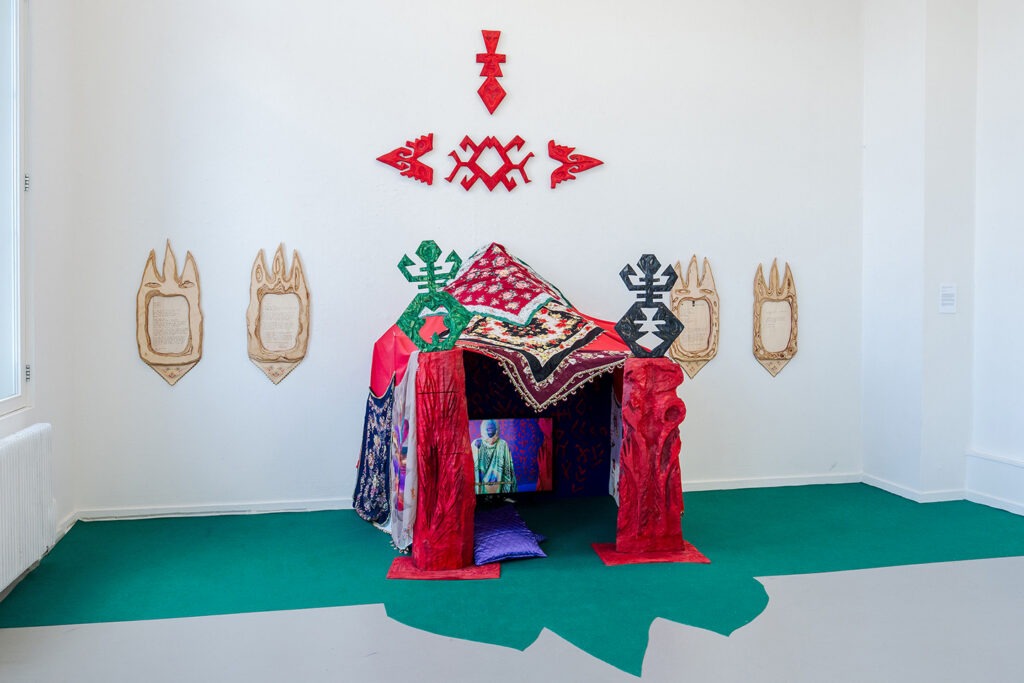
This distinction finds a strong counterpart in Amsterdam based artist Müge Yılmaz’s botanically focused personal story in her video work A Brief History of Naturalisation (2026).[15] Yılmaz places her own process of acquiring citizenship alongside the tulip’s migration to the Netherlands and its cultural adaptation there. In the video, where personal narrative, humor, and elements of science fiction are interwoven, plant-human hybrids establish a surreal connection between these two stories. The tent-like nomadic structures that create the atmosphere of the work also allow feelings of citizenship, belonging, being in between, and exclusion to be experienced spatially. Bringing the bureaucratic rituals of citizenship into confrontation with the idea of becoming a “citizen of the world,” the work sets the mobility of humans and plants against the fixity of national borders.
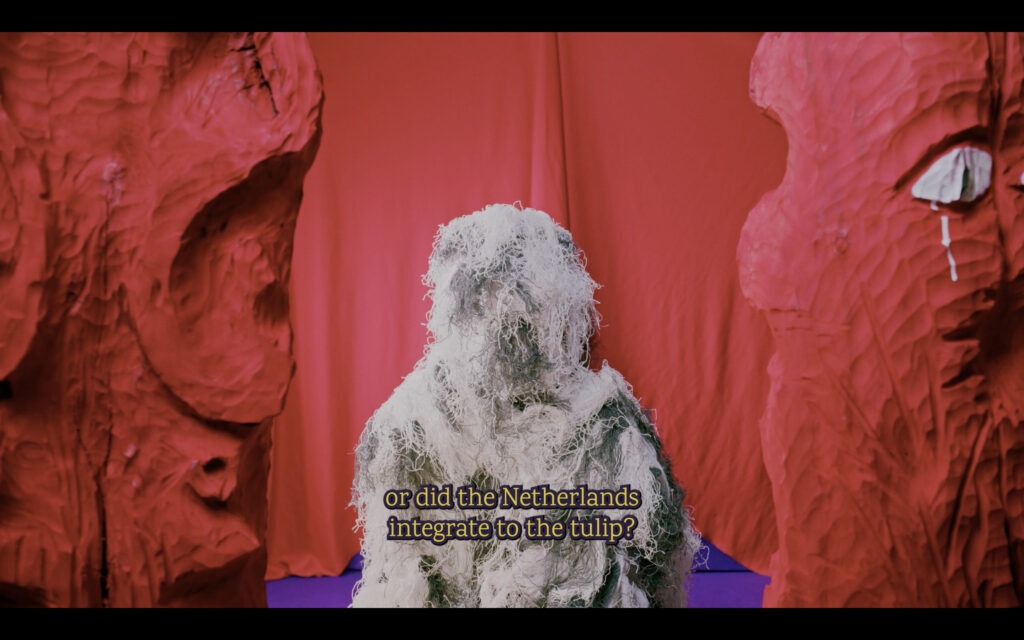
Müge’s intertwining of the tulip’s migration to the Netherlands with her own citizenship process shows how a botanical entity can be connected to politics of national identity and belonging. The movement of a plant from one geography to another is not simply the relocation of a species; it also means the creation of a new history around it, a new form of ownership, and a new narrative of belonging. When we think of the same thing in relation to turquoise, we can see that behind the appearance of a color as though it belongs to a national identity lies a much longer and more complex history of circulation.
As I focused on expression and relations of power through language, I am now questioning what I have been thinking about through pigment. Through what processes does it become possible for something to be named, put into circulation, made visible, or claimed as one’s own? When a pigment is extracted in one place and processed in another geography, is it only the pigment itself that moves, or does a history, a name, a memory, and a relation of power also move with it? Although this may sound rhetorical, I am actually asking this sincerely. How much does the name of a color change its history? When does a color become a cultural property? I think examples such as turquoise leave these questions open rather than providing definitive answers. The geological origin of the stone can be separated from the geography indicated by the name given to it. This requires us to trace the circulation of a color rather than fix its “origin.” In a sense, the name records not where the material came from, but the routes through which it became known.
At this point, it is possible to return to the question of “expression” with which I began. Expression can be thought of not only as something that takes place through language, but as a process that moves between materials, pigments, bodies, and the senses. In fact, language and pigment may be closer to one another than we think. After all, both name, classify, and put the world into circulation. Following the name of a color, in this sense, becomes a way of tracing a material and the history that moves along with it. In other words, the only question this text has really been concerned with is what a color carries with it when it moves. Because the story of pigment shows that color is never only on the surface. Color can be a carrier moving between material and memory, body and geography, trade and identity, expression and power.
This is precisely where the contribution of this research to curatorial practice lies: in bringing artistic research, material examination, and critical thinking together to develop a research method that can make overlooked material histories visible. We can approach pigments not only as subjects of art history or raw materials of artistic production, but as materials that carry ecological, social, societal, and political relations. In this way, a step can be taken toward considering how curatorial practice can contribute to rereading these histories and producing alternative narratives to dominant cultural classifications. Through this, curatorial practice can move beyond being merely a means of transmitting existing knowledge and become a form of research that produces new knowledge through the material itself.
[1] Ball, Philip. Bright Earth: Art and the Invention of Color. New York: Farrar, Straus and Giroux, 2002.
[2] Gizem Hız, Renk Üstüne Sohbetler podcast archive, Manifold. https://manifold.press/indeks/renk-ustune-sohbetler
[3] Aslı Çavuşoğlu, Lahana pembesi / Soğan yeşili / Portakal mavisi exhibition, Ek Biç Ye İç, 2022.
[4] Umut Altıntaş, Beyazın Boşlukla İlişkisi, 24.06.2021. Manifold. https://manifold.press/umut-altintas-beyazin-boslukla-iliskisi
[5] Batchelor, David. Chromophobia (2000). London: Reaktion Books, pages 22–23.
[6] Pera Museum, Zevk Meselesi exhibition, 2021. https://www.peramuzesi.org.tr/sergi/zevk-meselesi/1265
[7] David Speed, “They’re Stealing Colour from Your World,” Creative Rebels, Substack, 24 July 2024. https://creativerebels.substack.com/p/theyre-stealing-colour-from-your
[8] Gökhan Akçura, “Öküzbaş Çiviti’nin Türkiye Maceraları,” Manifold, 03.03.2026. https://manifold.press/okuzbas-civiti-in-turkiye-maceralari
[9] Yves Klein’s International Klein Blue also allows us to think about this from another angle. Klein registered the blue formula he developed in 1960 under the name IKB. The issue here is not simply the aesthetic effect of a particular ultramarine blue, but how an artist, by associating a color with a particular formula, method of production, and his own name, branded it within the history of art. Of course, it is not possible to draw a direct parallel between Kapoor and Klein. But when considered together, they allow us to question how color can move beyond being a material property and become something that is named, branded, claimed as property, and transformed into economic value within the art world.
[10] The controversy surrounding Anish Kapoor and Vantablack brings this question into the art world itself. When Kapoor acquired exclusive rights in 2016 to the use of the Vantablack material, which absorbs almost all light, in the field of art, the question “Can an artist own a color?” came to the fore. Vantablack was not actually a pigment invented by Kapoor; it was a carbon nanotube based material developed by Surrey NanoSystems, with technical applications beyond the field of art. Nevertheless, Kapoor’s monopolization of the right to use it within the art world showed that pigment could become not merely a color, but also an object of legal and economic ownership.
[11] Fourth Bunny, from İrem Günaydın’s exhibition Sanatçı Hakkında, which was on view at The Pill until last July, offers a different contemporary art example of this. The rabbit silhouette that the artist had used previously is transformed here into a gigantic fiberglass Bugs Bunny sculpture in toxic green. This time, color functions less as the bearer of the history of a particular pigment than as an alarm: it becomes a warning sign emerging in the midst of a decayed and deteriorating system, financial disaster, and systematic forgetfulness. The use of fiberglass in opposition to the “noble” permanence of classical sculpture, together with the panic and danger made visible by toxic green, shows how color can become a symbolic political language.
[12] Barajdan Sızanlar, SALT Beyoğlu, 22 April–23 August 2026. https://saltonline.org/tr/3036
[13] Moore, Jeffrey. The Memory Artists (2004). Viking Canada.
[14] Since 2019, Öztekin has been working with the archive of the late trans poet and activist Ceyhan Fırat, reconfiguring texts, photographs, and found objects and bringing these materials together with photographs and diaries from his own archive, particularly those relating to trans resistance on Ülker Sokak. For example, in works from the Yepyeni Gözler series, he brings the accidental traces of color that have formed on the backs of photographs and sheets of paper back onto the surface using ink, acrylic, and charcoal.
[15] Based on the exhibition The Importance of Soil, which was on view at the Amsterdam based Working Title gallery in spring 2026. Müge Yılmaz, with the artist’s permission.
In this text, Pelin Tan considers land and landscape as layered archives that carry the memories of human and more-than-human beings. Moving from walks through the Tigris basin to seed...
read
In the series Experiments and Stumbles on Collaboration, İpek Çınar writes about how coming together and being "we" gets built —and where it falters— through the experience of running an...
read
Whistleblowing actions have transformed our perception of surveillance and control in today’s information society. This text examines the effects of whistleblowing as a form of dissent on politics, society, and...
read